
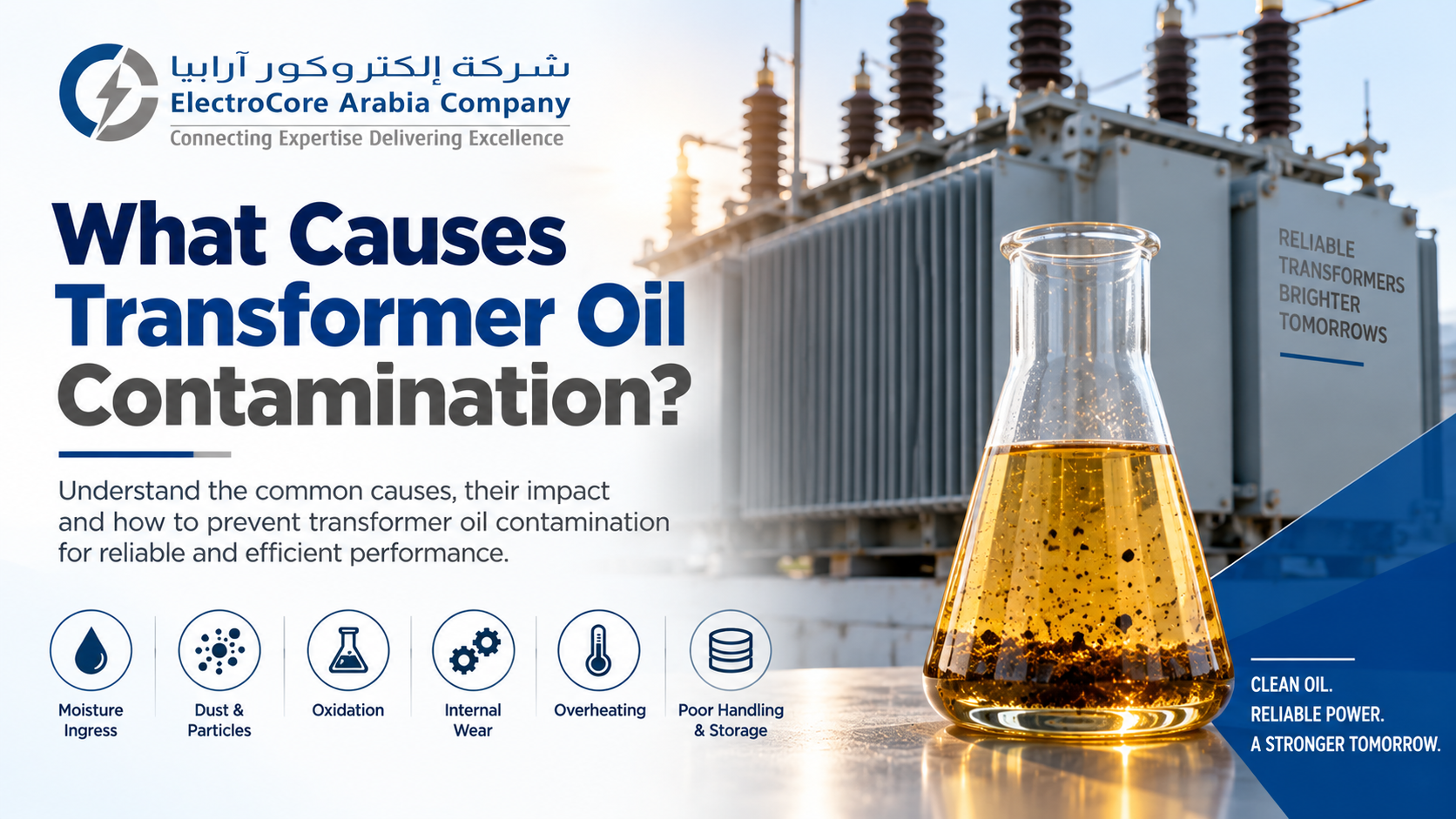
Transformer oil is one of the most important components of an oil-filled transformer. It performs two essential functions: providing electrical insulation between energized components and transferring heat away from the transformer core and windings. When the oil becomes contaminated, both of these functions can be affected, increasing the risk of overheating, insulation deterioration, electrical faults, and unplanned downtime.
Transformer oil contamination can occur for several reasons, including moisture ingress, dust and particles, oxidation, carbon deposits, internal equipment deterioration, poor oil handling, and environmental exposure. Identifying these causes early and implementing appropriate oil testing and maintenance practices can significantly improve transformer reliability.
ElectroCore Arabia provides transformer testing, maintenance, diagnostics, repair, and oil-related services designed to support reliable power infrastructure across demanding industrial environments.
Transformer oil contamination occurs when unwanted substances or degradation products enter the insulating oil or develop within it during operation.
Clean transformer oil should have appropriate dielectric strength, low moisture content, good oxidation stability, and minimal suspended contaminants. As contamination increases, the oil’s ability to insulate and cool the transformer can gradually decline.
Common contaminants include:
Some contaminants enter from outside the transformer, while others are generated internally as the transformer operates.
One of the most common causes of transformer oil contamination is moisture.
Water can enter a transformer through damaged seals, gaskets, breathers, maintenance activities, condensation, or exposure to humid environmental conditions. Poor storage and handling of transformer oil can also introduce moisture before the oil is even added to the equipment.
Moisture is particularly harmful because it can reduce the dielectric strength of transformer oil and negatively affect the solid insulation system.
Transformers operating in humid, coastal, offshore, or harsh industrial environments may require particularly careful moisture control.
Regular oil testing can help identify increasing moisture levels before they become a serious operational problem.
Solid particles can enter transformer oil during maintenance, oil transfer, equipment servicing, or through inadequate sealing.
Dust, fibres, rust particles, carbon, and other suspended materials can affect the insulating properties of the oil. Particles may also accumulate in different areas of the transformer and contribute to further deterioration.
This is why clean pumps, hoses, storage tanks, filtration equipment, and sampling containers are essential when handling transformer oil.
Proper handling procedures can prevent many forms of avoidable contamination.
Transformer oil naturally changes over time because of exposure to oxygen, heat, and operating conditions.
Oxidation can produce acids and other degradation products. Over time, these products can contribute to sludge formation and deterioration of the oil and solid insulation system.
High operating temperatures can accelerate oxidation and ageing.
For this reason, transformer operating temperature and loading conditions should be considered alongside oil test results when evaluating transformer health.
Our guide on Why Transformer Oil Quality Matters explains how moisture, oxidation, contamination, and excessive heat can affect transformer oil quality.
Excessive heat can accelerate the deterioration of transformer oil and insulation.
Overloading, inadequate cooling, cooling-system problems, loose connections, and internal electrical faults can all contribute to abnormal temperatures.
Internal faults can also generate gases and carbonaceous materials within the oil. Dissolved Gas Analysis (DGA) is therefore an important diagnostic method for oil-filled transformers because it can help identify gases associated with thermal and electrical faults.
Oil contamination should not always be viewed as an isolated oil-quality issue. In some cases, changes in oil condition may indicate an underlying transformer problem.
Electrical arcing and repeated switching operations can generate carbon particles and other contaminants.
This is particularly relevant to oil-filled on-load tap changers (OLTCs), where switching contacts are exposed to electrical arcing during operation.
Over time, contact wear, burning, pitting, and carbon deposits can affect OLTC oil condition.
For more information, see our guide on OLTC Maintenance for Power Transformers, which discusses oil inspection and treatment as part of OLTC maintenance.
Internal transformer components are exposed to electrical, thermal, and mechanical stresses for long periods.
Corrosion or deterioration of metal components can introduce metallic particles into the oil. These particles may affect oil cleanliness and, depending on their nature and concentration, potentially contribute to electrical problems.
A visual inspection combined with oil analysis and other diagnostic tests can help determine whether contamination is related to internal equipment deterioration.
Transformer oil can become contaminated before it enters the transformer.
Improper storage containers, open exposure to air, dirty transfer equipment, water contamination, and mixing with unsuitable fluids can reduce oil quality.
Transformer oil should therefore be stored in clean, dry, properly sealed containers and protected from unnecessary exposure to moisture, dust, and environmental contaminants.
Oil should also be tested before use when there is uncertainty about its condition.
Maintenance activities can unintentionally introduce contaminants into transformer oil.
Opening a transformer, replacing components, draining and refilling oil, or performing repairs can expose the system to moisture, dust, fibres, and other foreign materials.
Technicians should use appropriate procedures and clean equipment during maintenance and oil-transfer operations.
Representative oil sampling is also important because inaccurate or contaminated samples can lead to misleading test results.
Regular transformer oil testing provides valuable information about oil condition.
Depending on the transformer type, application, operating history, and maintenance strategy, tests may include:
The results should ideally be compared with previous test results to identify trends.
A single test result provides useful information, but historical data can provide a much clearer picture of how transformer oil condition is changing over time.
ElectroCore Arabia’s Transformer Condition Assessment approach considers oil condition alongside electrical testing, insulation condition, cooling performance, operating history, and other transformer-health indicators.
Contaminated oil can affect transformer performance in several ways.
Potential consequences include:
The severity depends on the type and concentration of contamination and the overall condition of the transformer.
For critical transformers, ignoring deteriorating oil condition can result in significantly higher repair costs and operational risks.
Prevention should be part of a structured transformer maintenance programme.
Important practices include:
Testing transformer oil periodically helps identify moisture, oxidation, contamination, and other changes before they become major problems.
Store oil in clean, dry, sealed containers and protect it from rain, humidity, dust, and other environmental contaminants.
Pumps, hoses, tanks, filtration units, and sampling equipment should be clean and suitable for transformer oil applications.
During transformer maintenance and oil transfer, minimize unnecessary exposure to humid air and environmental moisture.
Excessive loading can increase operating temperature and accelerate oil and insulation ageing.
Proper cooling helps control transformer operating temperatures and reduce thermal stress.
Recording oil test results over time makes it easier to identify deterioration trends and determine when further investigation or treatment may be required.
Oil filtration or purification may be appropriate when testing identifies moisture, suspended particles, or other contaminants that can be removed through an appropriate treatment process.
However, filtration should not be based solely on the age of the oil or transformer. The treatment method should be selected according to oil test results, transformer condition, operating history, contamination type, and manufacturer recommendations.
A practical maintenance approach is:
Oil Sampling → Laboratory Testing → Condition Assessment → Filtration/Purification → Post-Treatment Testing
ElectroCore Arabia also provides Transformer Oil Filtration Services, where oil condition and test results can be used to determine the appropriate treatment approach.
Transformer oil contamination is often connected to broader equipment-condition issues. Therefore, oil testing should form part of a comprehensive transformer maintenance programme rather than being treated as a standalone activity.
Regular maintenance can help identify developing problems involving insulation, bushings, cooling systems, connections, tap changers, and other components.
Our Power Transformer Maintenance Guide explains how maintenance frequency can depend on transformer age, loading, operating environment, oil condition, historical test results, manufacturer recommendations, and asset criticality.
Transformer oil contamination can result from moisture ingress, dust and particles, oxidation, overheating, internal faults, carbon deposits, corrosion, poor storage, and improper maintenance practices.
Because transformer oil provides both insulation and cooling, contamination can gradually affect transformer reliability and increase the risk of electrical and thermal problems.
The best approach is proactive: perform regular oil testing, maintain clean handling practices, control moisture, monitor operating conditions, and use appropriate filtration or treatment when test results indicate a need.
For critical electrical infrastructure, combining transformer oil analysis with comprehensive condition assessment and preventive maintenance can help improve reliability, reduce unexpected failures, and extend transformer service life.
ElectroCore Arabia supports transformer owners and industrial operators with transformer testing, diagnostics, maintenance, repair, refurbishment, and oil-related services across Saudi Arabia.



Copyright © 2026
ElectroCore Arabia Company. All Rights Reserved. Powered by Webtechnomind IT Solutions Pvt. Ltd
Sunday to Thursday: 8 am to 5 pm
Saturday: 9 am to 4 pm
Friday: Holiday

Copyright © 2026
ElectroCore Arabia Company. All Rights Reserved. Powered by Webtechnomind IT Solutions Pvt. Ltd