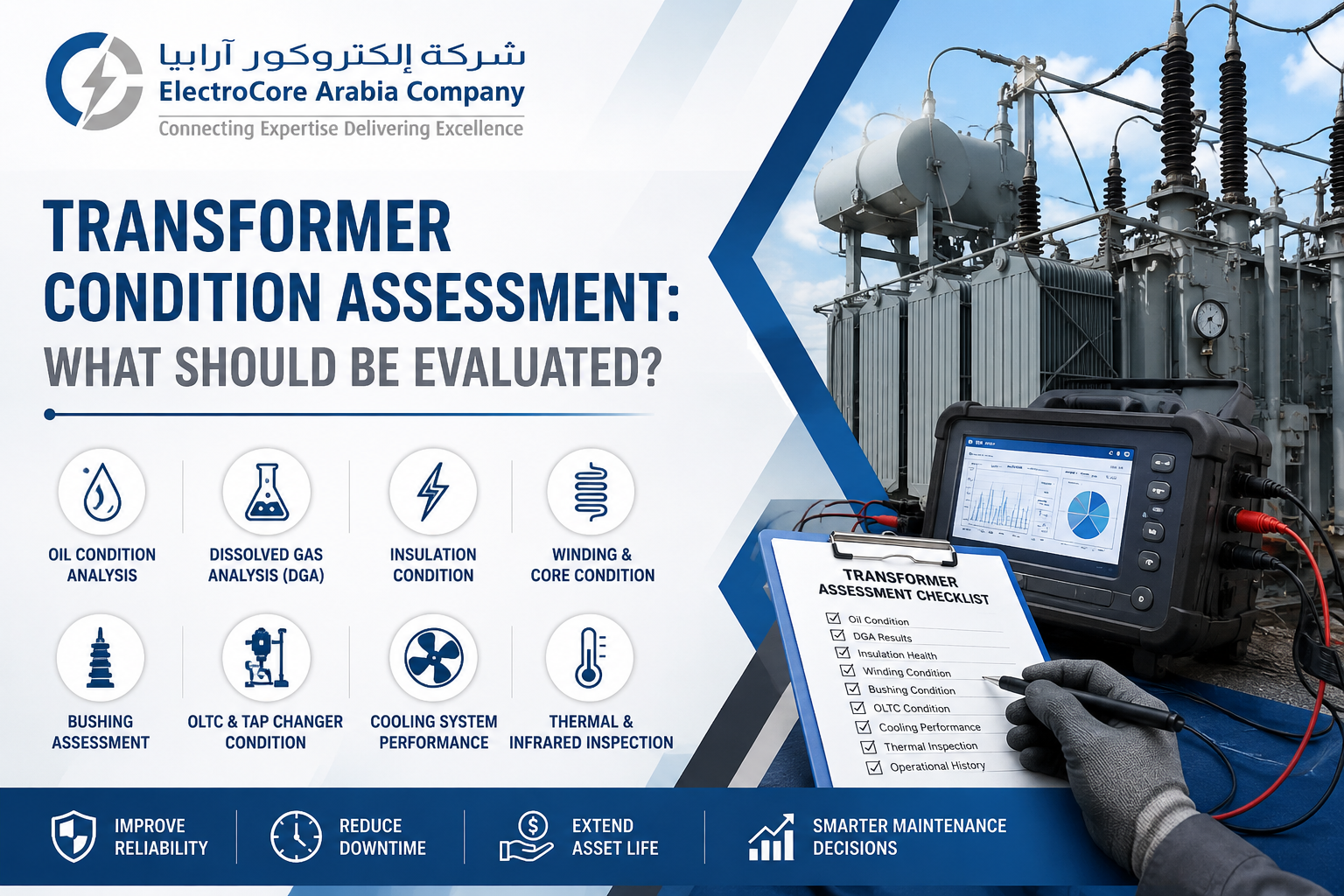
A transformer is one of the most critical assets in an electrical power system. Whether used in a utility substation, industrial facility, commercial installation, or transmission network, a transformer must operate reliably under continuous electrical, thermal, and mechanical stress.
Over time, factors such as insulation ageing, overheating, moisture, oil deterioration, mechanical stress, overloading, short-circuit events, and environmental conditions can affect transformer performance. A transformer condition assessment helps identify these issues before they develop into major failures.
Modern condition assessment is not based on a single test. It combines visual inspection, electrical testing, oil analysis, mechanical checks, operational data, and historical trends to determine the overall health of the transformer.
IEEE’s current IEEE C57.170-2025 specifically provides guidance for condition assessment of liquid-immersed transformers, reactors, and their components.
Transformer condition assessment is a systematic evaluation of a transformer’s physical, electrical, thermal, mechanical, and insulation condition.
The objective is to determine:
A proper assessment allows asset owners to move from reactive maintenance toward condition-based and predictive maintenance.
The first step in transformer condition assessment is a detailed visual and physical inspection.
Technicians should examine the transformer tank, bushings, conservator, radiators, valves, connections, cooling equipment, control panels, and other external components.
Important inspection points include:
Oil leakage deserves particular attention because it can result in reduced insulation performance, overheating, environmental concerns, and eventually transformer failure.
For oil-filled transformers, insulating oil provides both electrical insulation and heat transfer. Therefore, oil condition is an important indicator of transformer health.
Oil testing may evaluate parameters such as:
Deteriorated oil can reduce dielectric strength and accelerate insulation ageing.
Oil analysis should therefore be considered alongside other diagnostic results rather than evaluated in isolation.
Dissolved Gas Analysis (DGA) is one of the most valuable diagnostic techniques for oil-immersed transformers.
When internal electrical or thermal faults occur, the insulating oil and solid insulation can decompose and generate gases. The types and concentrations of these gases can provide information about possible internal problems.
Common gases evaluated include:
DGA can help identify conditions associated with overheating, partial discharge, arcing, and other developing faults. IEEE guidance specifically addresses interpretation of gases generated in mineral-oil-immersed transformers.
Importantly, technicians should evaluate gas concentration, gas generation rate, and historical trends, rather than relying on a single sample.
The insulation system is fundamental to transformer reliability. Ageing, moisture, contamination, thermal stress, and electrical faults can progressively weaken insulation.
Insulation resistance testing measures resistance between windings and ground or between selected windings. A significant change from historical results may indicate moisture, contamination, or insulation deterioration.
Tan delta testing helps evaluate dielectric losses and can provide information about insulation deterioration, moisture, and contamination.
DFR can provide additional information about moisture and the condition of transformer insulation systems.
No individual insulation test should automatically be treated as a complete assessment. Results should be interpreted alongside transformer age, temperature, previous measurements, and other diagnostic information.
Transformer windings are exposed to electrical, thermal, and mechanical stresses throughout their operating life.
Condition assessment may include:
Sweep Frequency Response Analysis (SFRA) can be particularly useful when investigating potential mechanical movement or deformation of windings following transportation, short-circuit events, or other mechanical stresses.
Comparing current results with factory or historical fingerprints can help identify changes in winding and core mechanical integrity.
The transformer core provides the magnetic path required for energy transfer. Problems involving core grounding, insulation, or abnormal core conditions can contribute to overheating and other operational issues.
During condition assessment, technicians may evaluate:
Core assessment is particularly important when other diagnostic results indicate unexplained thermal or electrical abnormalities.
Bushings provide an insulated connection between the transformer’s internal conductors and external electrical system.
Because bushing failure can have serious consequences, their condition should be evaluated during transformer assessment.
Inspection may include:
Infrared thermography can also help identify abnormal temperature patterns around bushings and connections.
The On-Load Tap Changer (OLTC) is another important transformer component requiring condition assessment.
The OLTC controls transformer voltage by changing the effective turns ratio while the transformer is energized.
Assessment may include:
For critical transformers, OLTC condition should be monitored as part of the overall asset health program.
A transformer must effectively remove heat generated during operation.
Cooling systems may include radiators, fans, pumps, oil circulation systems, or combinations of these technologies.
Assessment should verify:
A transformer that operates at excessive temperatures can experience accelerated insulation ageing and reduced service life.
Thermographic inspection provides a non-invasive way to identify abnormal temperature patterns.
Technicians can inspect:
Hot spots may indicate loose connections, excessive resistance, overloaded components, poor cooling, or other developing problems.
ElectroCore Arabia includes infrared thermography and condition-based monitoring within its transformer maintenance and diagnostic capabilities.
A transformer’s current condition cannot be evaluated properly without understanding its operating history.
Important information includes:
Two transformers of the same age can have very different health conditions because their operating environments and loading histories may be completely different.
One of the most important aspects of transformer condition assessment is trend analysis.
A single test result provides a snapshot. Repeated measurements provide a much better understanding of how the transformer is changing.
For example, technicians can compare:
A gradual deterioration trend may indicate developing ageing, while a sudden change could indicate a new fault or abnormal event.
The final stage is to combine the available information into an overall transformer health assessment.
Factors may include:
This information can help determine whether the transformer should continue operating normally, receive increased monitoring, undergo maintenance, be refurbished, or be considered for replacement.
Transformer failures can result in unexpected outages, production losses, equipment damage, safety risks, and expensive emergency repairs.
A professional condition assessment helps organizations identify potential problems before they become major failures.
ElectroCore Arabia provides transformer testing, diagnostics, oil analysis, condition monitoring, maintenance, repair, and refurbishment services. Its capabilities include electrical testing such as TTR, IR, Tan Delta, SFRA and PD, as well as oil diagnostics including DGA, BDV, moisture and acidity testing.
Transformer condition assessment should never depend on a single test or inspection. A reliable assessment combines physical inspection, oil diagnostics, DGA, insulation testing, winding and core evaluation, bushing inspection, OLTC assessment, cooling system checks, thermal inspection, operating history, and historical trend analysis.
The goal is not simply to determine whether a transformer is working today. The goal is to understand its current health, identify developing problems, estimate future reliability, and make informed maintenance or asset-management decisions.
For critical electrical infrastructure, regular condition assessment can support predictive maintenance, reduce unplanned outages, extend transformer service life, and improve overall power-system reliability.
ElectroCore Arabia provides comprehensive transformer testing, condition assessment, maintenance, repair, refurbishment, and diagnostic services for industrial and utility applications in Saudi Arabia.
Read More:
1. When Should a Transformer Be Repaired Instead of Replaced?
Copyright © 2026
ElectroCore Arabia Company. All Rights Reserved. Powered by Webtechnomind IT Solutions Pvt. Ltd
Sunday to Thursday: 8 am to 5 pm
Saturday: 9 am to 4 pm
Friday: Holiday
Copyright © 2026
ElectroCore Arabia Company. All Rights Reserved. Powered by Webtechnomind IT Solutions Pvt. Ltd