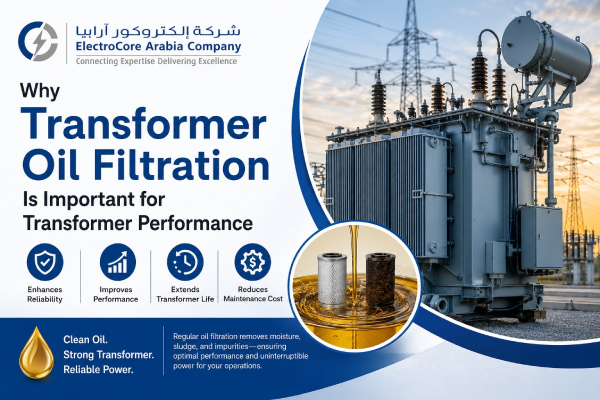
Transformers are among the most important assets in electrical power systems. They play a critical role in power generation, transmission, distribution, manufacturing, oil and gas, petrochemical, and other industrial applications. Because transformers often operate continuously under demanding electrical and thermal conditions, proper maintenance is essential for reliable performance.
One of the most important maintenance activities is transformer oil filtration.
Transformer oil serves two primary purposes: electrical insulation and cooling. Over time, the oil can become contaminated with moisture, dust, suspended particles, gases, sludge, and oxidation products. These contaminants can reduce the oil’s insulating properties, affect heat transfer, accelerate insulation ageing, and increase the risk of transformer failure.
Regular transformer oil filtration and condition monitoring can therefore play an important role in maintaining transformer reliability, performance, and service life.
Transformer oil filtration is the process of removing unwanted contaminants from insulating oil to restore or maintain its required quality.
Depending on the condition of the oil, professional filtration and purification systems may use different processes, including:
The exact treatment required depends on oil test results, transformer condition, operating environment, and the type of contamination present.
The primary objective is to maintain transformer oil in a clean, dry, and electrically suitable condition.
Transformer oil is an essential part of the transformer’s insulation system. It provides insulation between energized components and helps prevent unwanted electrical discharges.
When oil becomes contaminated with moisture or particles, its dielectric strength can decrease. Poor oil quality can increase the possibility of insulation problems and electrical faults.
Transformer oil filtration helps remove contaminants and supports the oil’s ability to provide effective electrical insulation.
Moisture is one of the biggest concerns in transformer insulation systems.
Water can enter a transformer through leaks, condensation, breathing systems, poor storage practices, or maintenance activities. Even relatively small amounts of moisture can negatively affect insulating oil and solid insulation materials such as paper and pressboard.
Vacuum dehydration and other suitable purification processes can help reduce moisture levels in transformer oil.
Maintaining low moisture levels helps protect the transformer’s insulation system and supports reliable operation.
Transformer oil is not only an insulating medium; it also transfers heat away from the transformer’s core and windings.
During normal operation, transformers generate heat because of electrical losses. The oil circulates through the transformer and transfers this heat to the cooling system.
Clean and properly conditioned oil supports effective heat transfer. Contaminated or degraded oil can negatively affect the overall cooling performance of the transformer.
Effective oil filtration is therefore an important part of maintaining the thermal performance of transformers.
Transformer oil can accumulate dust, carbon particles, fibers, sludge, and other contaminants during its operating life.
These contaminants can affect the dielectric properties of the oil and may contribute to deposits on internal transformer components.
A suitable filtration system can remove suspended particles and help maintain cleaner insulating oil.
This is particularly important for transformers operating in demanding industrial environments where contamination can occur more frequently.
Transformer oil naturally deteriorates over time because of heat, oxygen, moisture, electrical stress, and other operating conditions.
Oil oxidation can produce acids, sludge, and other degradation products. If these substances accumulate, they can negatively affect the oil and insulation system.
Oil purification and filtration can help manage certain contaminants associated with oil ageing. However, filtration should be based on proper oil testing and condition assessment rather than being treated as a universal solution for every form of oil degradation.
Unexpected transformer failure can result in significant operational and financial consequences.
A transformer outage may interrupt production, affect power distribution, create maintenance costs, and cause extended downtime.
Regular transformer oil testing and filtration can help maintenance teams identify and address oil-quality problems before they contribute to more serious operational issues.
For critical electrical infrastructure, oil filtration should therefore be considered part of a broader preventive transformer maintenance strategy.
Transformers are significant capital investments, and replacing one can be expensive and time-consuming.
Maintaining the quality of transformer oil helps protect the insulation system and supports the transformer’s cooling and electrical functions.
By controlling moisture and contamination and monitoring oil degradation, organizations can improve asset management and potentially extend the useful operating life of their transformers.
The contaminants addressed through transformer oil filtration depend on the filtration technology being used. Common concerns include:
Moisture: Water can reduce dielectric strength and accelerate insulation ageing.
Solid particles: Dust, fibers, carbon, and other particles can negatively affect oil cleanliness and insulation performance.
Sludge: Oxidation-related deposits can accumulate in ageing transformer oil.
Dissolved gases: Vacuum treatment can remove certain dissolved gases from insulating oil.
Degradation products: Ageing can cause changes in oil chemistry that may require additional treatment or specialist assessment.
Because every transformer has different operating conditions, oil analysis should be used to determine the appropriate treatment.
Transformer oil testing and filtration are complementary but different processes.
Oil testing determines the condition of the transformer oil through measurements such as dielectric strength, moisture, acidity, resistivity, and other relevant parameters.
Oil filtration is the treatment process used to remove certain contaminants and improve oil condition.
A practical maintenance cycle may follow this approach:
Oil Sampling → Laboratory Testing → Condition Assessment → Filtration/Purification → Post-Treatment Testing
Dissolved Gas Analysis (DGA) can also provide valuable information about potential electrical or thermal issues occurring inside an oil-filled transformer.
This combination of testing, diagnosis, treatment, and follow-up testing allows maintenance teams to make better-informed decisions.
There is no single filtration schedule suitable for every transformer.
The requirement for transformer oil filtration depends on factors such as:
For this reason, condition-based maintenance is often more effective than relying only on a fixed filtration schedule.
If oil analysis indicates contamination, moisture, or deterioration, qualified transformer professionals can determine whether filtration, dehydration, reclamation, oil replacement, or another maintenance action is appropriate.
Professional transformer oil filtration can provide several important benefits:
The filtration equipment and treatment process should always be selected according to the transformer’s technical requirements and oil condition.
For organizations operating critical electrical infrastructure in Saudi Arabia, professional transformer maintenance is essential for maintaining reliable power systems.
ElectroCore Arabia provides transformer-related services including inspection, diagnostics, maintenance, repair, commissioning, and oil filtration solutions for industrial and power-sector applications.
Its oil filtration solutions are designed to address common transformer oil concerns such as moisture, particles, dissolved gases, and degradation products.
Professional transformer oil filtration can be particularly valuable for industries where transformer reliability directly affects production and operational continuity, including power generation, oil and gas, petrochemical, manufacturing, infrastructure, cement, steel, and other industrial facilities.
Transformer oil plays a critical role in both the insulation and cooling systems of a transformer. As the oil ages and becomes exposed to moisture, particles, gases, heat, and oxidation, its performance can gradually deteriorate.
Transformer oil filtration helps control many of these contaminants and supports the oil’s ability to perform its essential functions.
However, filtration should not be viewed as a standalone maintenance activity. The best approach combines regular oil testing, condition monitoring, professional filtration, preventive maintenance, and appropriate diagnostic techniques.
For companies managing critical transformers, investing in proper oil maintenance can help improve reliability, protect insulation, reduce operational risks, and support longer equipment life.
A clean and properly conditioned transformer oil system is ultimately an important part of maintaining safe, efficient, and reliable transformer performance.
Copyright © 2026
ElectroCore Arabia Company. All Rights Reserved. Powered by Webtechnomind IT Solutions Pvt. Ltd
Sunday to Thursday: 8 am to 5 pm
Saturday: 9 am to 4 pm
Friday: Holiday
Copyright © 2026
ElectroCore Arabia Company. All Rights Reserved. Powered by Webtechnomind IT Solutions Pvt. Ltd