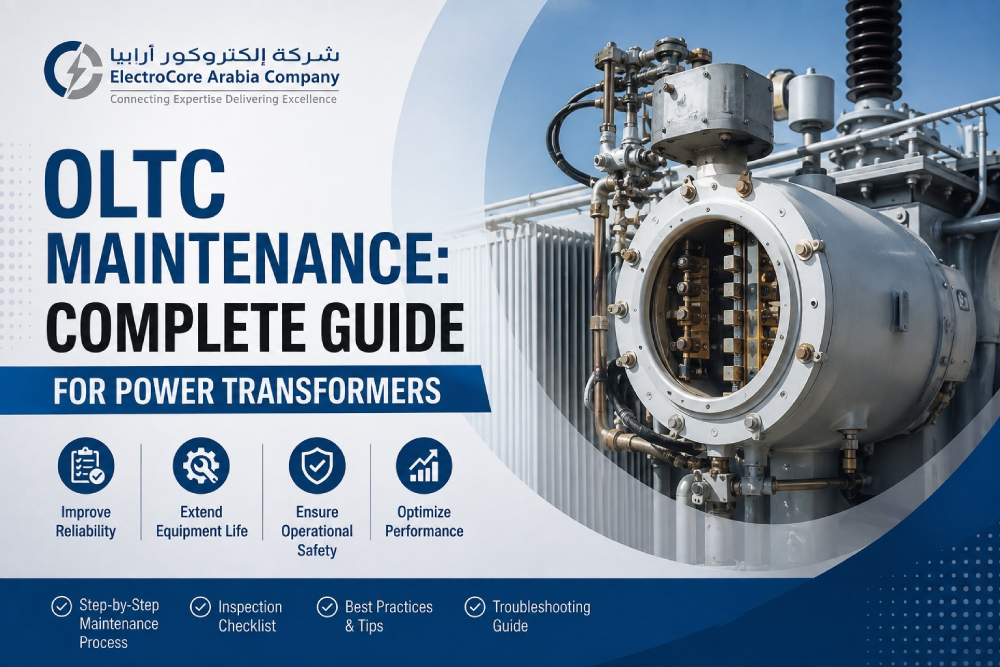
On-load tap changers (OLTCs) are critical components of modern power transformers. They allow transformer voltage ratios to be adjusted while the transformer remains energized and supplying its load. This capability helps maintain stable voltage levels despite changes in load demand and power-system conditions.
Because an OLTC operates under electrical load and involves mechanical movement, switching contacts, arcing, and insulation systems, it requires regular inspection and maintenance. Poorly maintained OLTC components can lead to contact wear, overheating, switching problems, oil degradation, voltage instability, and potentially serious transformer failures.
A structured OLTC maintenance program helps utilities, industrial plants, substations, and other power facilities improve transformer reliability and reduce unexpected outages.
An On-Load Tap Changer is a mechanical and electrical switching system installed on a power transformer to change the transformer’s effective turns ratio without interrupting the electrical supply.
During operation, the OLTC moves between different tap positions to regulate the transformer’s output voltage. Depending on the design, the system typically includes components such as:
The OLTC is one of the transformer components subjected to significant electrical and mechanical stress. Consequently, its condition should be monitored as part of the overall transformer maintenance strategy.
Regular OLTC maintenance is essential because the tap changer operates frequently in many transformer applications. Every switching operation can contribute to mechanical wear and electrical contact erosion.
Key benefits include:
A properly maintained OLTC can accurately change tap positions and help maintain the required transformer output voltage.
Switching contacts experience electrical arcing and gradual erosion. Inspection and timely replacement of worn contacts can prevent serious operational problems.
OLTC problems can place additional stress on the transformer. Preventive maintenance helps identify developing problems before they affect other components.
A healthy OLTC reduces the possibility of tap-position failures, abnormal switching, and unexpected transformer outages.
Identifying minor defects during scheduled inspections is generally preferable to dealing with emergency repairs following an OLTC failure.
Several issues can develop in an OLTC during normal service. Common problems include:
Early identification of these conditions is an important objective of preventive and predictive maintenance.
The exact maintenance procedure depends on the OLTC design, transformer manufacturer, operating history, and maintenance requirements. However, a typical maintenance program may include the following activities.
The first step is a detailed visual inspection of the OLTC and associated equipment.
Technicians may inspect:
Any abnormal condition should be documented and investigated.
OLTC contacts are exposed to electrical arcing during switching operations. Over time, this can result in contact erosion, pitting, burning, or carbon deposits.
During an overhaul, contacts should be inspected for:
Where contact wear exceeds the manufacturer’s recommended limits, replacement may be necessary.
In oil-filled OLTCs, the insulating oil can become contaminated as a result of repeated switching operations. Carbon particles, moisture, and other contaminants can affect oil performance.
Oil maintenance may involve:
Oil condition should be evaluated according to the applicable equipment and manufacturer requirements rather than relying only on a fixed replacement schedule.
The motor-drive mechanism moves the OLTC between tap positions. Its condition is therefore essential to reliable operation.
Maintenance can include checking:
The mechanism should operate smoothly without abnormal vibration, noise, or excessive resistance.
Contact resistance testing helps identify abnormal resistance within the OLTC switching circuit.
An increase in contact resistance can indicate:
Measurements should be compared with manufacturer specifications and previous test results to identify trends.
OLTC switching involves a defined mechanical and electrical sequence. Timing tests can verify that the switching operation occurs correctly.
Testing may evaluate:
Abnormal timing can indicate problems within the diverter switch, drive mechanism, contacts, or associated components.
After maintenance, the OLTC should be tested through its available tap positions, where safe and appropriate.
The test should verify:
The objective is to confirm that the OLTC performs correctly before the transformer returns to normal service.
There is no universal maintenance interval that applies to every OLTC. The appropriate schedule depends on the manufacturer’s recommendations, transformer design, number of switching operations, operating environment, load profile, oil condition, and previous inspection results.
A condition-based maintenance strategy can be particularly useful for critical transformers. Monitoring operating trends and historical test results allows maintenance teams to identify deterioration before it develops into a major failure.
For heavily loaded or frequently operated transformers, the OLTC may require more frequent inspection than a transformer with relatively low switching activity.
A reliable OLTC maintenance program should include:
Maintenance activities should always be performed by qualified personnel using appropriate isolation, grounding, PPE, and electrical safety procedures.
OLTC maintenance should not be considered separately from the overall transformer condition. A comprehensive transformer maintenance program can combine OLTC inspection with electrical and oil diagnostics.
Depending on the transformer and maintenance scope, testing may include:
Combining these diagnostic techniques provides a broader picture of transformer health and can help identify developing problems.
Professional transformer service providers can perform OLTC inspection, maintenance, overhaul, testing, and component replacement according to equipment requirements and applicable standards.
ElectroCore Arabia provides specialized transformer services including OLTC/DETC inspection, cleaning, lubrication, adjustment, overhaul, contact replacement, and timing testing. Its transformer service capabilities also include electrical testing, oil diagnostics, preventive maintenance, and condition-based monitoring.
ElectroCore Arabia has also completed OLTC overhaul work on a 60MVA power transformer, including diverter-switch inspection, contact resistance measurements, contact replacement, motor-drive inspection, oil-compartment cleaning, and switching-sequence testing.
OLTC maintenance is a critical part of power transformer maintenance. Because the OLTC operates under load and experiences both electrical and mechanical stresses, neglecting its condition can increase the risk of switching problems, voltage instability, overheating, and unexpected transformer outages.
Regular inspection, oil condition assessment, contact inspection, resistance testing, timing verification, and functional testing can significantly improve OLTC reliability. The most effective maintenance strategy combines manufacturer recommendations with operating history and condition-based diagnostics.
For utilities, substations, oil and gas facilities, industrial plants, and other critical power installations, investing in professional OLTC maintenance can help improve transformer availability, extend equipment service life, and reduce the risk of costly unplanned downtime.
Copyright © 2026
ElectroCore Arabia Company. All Rights Reserved. Powered by Webtechnomind IT Solutions Pvt. Ltd
Sunday to Thursday: 8 am to 5 pm
Saturday: 9 am to 4 pm
Friday: Holiday
Copyright © 2026
ElectroCore Arabia Company. All Rights Reserved. Powered by Webtechnomind IT Solutions Pvt. Ltd