
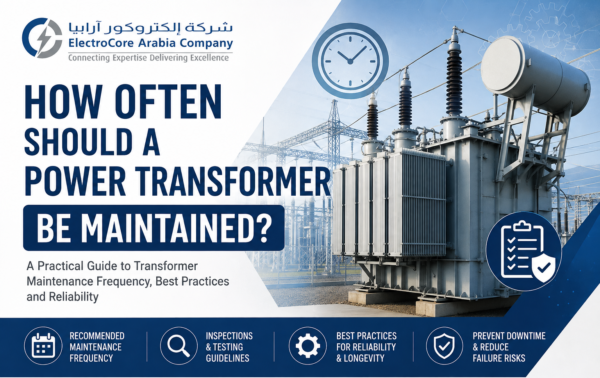
Power transformers are critical assets in industrial plants, substations, oil and gas facilities, manufacturing units, and other power-intensive operations. A transformer can operate reliably for many years, but only when it is properly inspected, tested, and maintained.
So, how often should a power transformer be maintained?
There is no single maintenance interval that applies to every transformer. The ideal power transformer maintenance schedule depends on factors such as transformer type, age, loading conditions, operating environment, criticality, manufacturer recommendations, and previous test results. Industry guidance also emphasizes developing maintenance intervals based on equipment condition, operating experience, and manufacturer recommendations.
For industrial facilities, a combination of routine inspections, periodic testing, oil analysis, and condition-based maintenance is generally more effective than waiting for a transformer failure.
A transformer operates continuously under electrical, thermal, and environmental stress. Over time, insulation can deteriorate, connections can loosen, oil quality can change, and cooling systems can become less effective.
Regular transformer preventive maintenance helps organizations:
Condition-based maintenance is particularly valuable because diagnostic results can help determine whether maintenance should be performed sooner or later rather than relying only on a fixed calendar.
A practical maintenance program can be divided into several levels.
For critical transformers, operators should monitor key operating parameters during normal operation.
Typical checks include:
These checks help identify abnormal conditions early.
For example, an unexpected increase in transformer temperature may indicate overloading, cooling problems, or another developing issue that requires investigation.
A more detailed visual inspection should be performed periodically, with the exact interval determined by the equipment and operating environment.
Technicians may inspect:
Transformers operating in dusty, humid, high-temperature, offshore, or heavily industrial environments may require more frequent inspection.
For many oil-immersed power transformers, an annual inspection and condition assessment is a useful baseline. Recent industry guidance commonly recommends annual visual inspection and oil sampling, with testing adjusted according to transformer condition and criticality.
Annual power transformer maintenance may include:
The purpose is not simply to complete a checklist. The objective is to identify trends that could indicate developing transformer problems.
Electrical testing should be performed according to the transformer manufacturer’s recommendations, applicable standards, asset criticality, and condition history.
Depending on the transformer, testing can include:
The exact combination and frequency should be determined by qualified electrical engineers and the applicable maintenance standards.
Historical test results are particularly important because changes over time can provide valuable information about transformer health.
For oil-immersed transformers, transformer oil is an important part of the insulation and cooling system.
Oil testing can help identify:
Dissolved Gas Analysis (DGA) is particularly useful for detecting gases generated by thermal or electrical faults inside oil-filled transformers.
Rather than treating oil testing as an isolated activity, maintenance teams should compare current results with previous results to identify changes and trends.
Major transformer maintenance is not necessarily required every year.
The timing depends on:
Older or heavily loaded transformers may require a more detailed condition assessment and more frequent intervention.
A transformer that shows abnormal test results should not simply wait until its next scheduled maintenance interval. Condition-based findings may require immediate investigation or corrective action.
Older transformers generally require closer monitoring because insulation, oil, bushings, seals, and other components can deteriorate over time.
Transformers operating close to their rated capacity for extended periods experience greater thermal stress. Continuous overloading can accelerate insulation ageing.
Dust, humidity, high ambient temperatures, salt exposure, chemical contamination, and offshore conditions can increase maintenance requirements.
This is especially important for industrial facilities and electrical infrastructure operating in demanding environments.
A transformer supplying a critical production process may require a more comprehensive maintenance program than a less critical unit.
The cost of an unexpected transformer failure should be considered when determining the maintenance strategy.
Maintenance schedules should evolve based on actual transformer condition. Significant changes in oil test results, DGA, insulation measurements, temperature trends, or other diagnostic data may justify additional testing.
There are two important approaches to transformer maintenance.
Preventive maintenance follows planned intervals.
Examples include:
Predictive maintenance uses equipment condition and diagnostic information to determine when action is required.
This may involve:
A modern transformer maintenance program can combine both approaches. Scheduled inspections provide a baseline, while condition monitoring helps identify when additional action is necessary.
| Maintenance Activity | Typical Frequency |
|---|---|
| Operating parameter monitoring | Daily / Routine |
| Visual inspection | Monthly / Periodic |
| Detailed condition inspection | Annually |
| Transformer oil inspection/testing | Periodically / Annually, depending on condition |
| DGA | Based on transformer criticality and condition |
| Electrical diagnostic testing | Periodic / Condition-based |
| Thermographic inspection | Periodic / As required |
| Major maintenance or overhaul | Based on condition, age and manufacturer recommendations |
Important: These intervals are general guidance, not a universal maintenance standard. The actual schedule should be developed according to the transformer manufacturer’s instructions, applicable standards, operating conditions, asset criticality, and historical condition data.
Do not wait for the next scheduled maintenance if you notice:
These symptoms should be investigated by qualified electrical professionals before the transformer develops a more serious failure.
Power transformer maintenance involves high-voltage electrical equipment and potentially hazardous operating conditions. Testing and maintenance should therefore be performed by appropriately qualified personnel using suitable procedures and test equipment.
A professional maintenance program should also maintain accurate records of:
These records help engineers identify deterioration and make better decisions about transformer lifecycle management.
For organizations operating in Saudi Arabia, choosing an experienced transformer service provider can help improve equipment reliability and reduce the risk of unexpected outages.
ElectroCore Arabia Company provides transformer inspection, diagnostics, maintenance, repair, testing, and commissioning services. The company states that its services are aligned with Saudi Electricity Company requirements and internationally recognized standards including IEC, IEEE, SAES, SASO, and NETA.
ElectroCore Arabia also provides specialized electrical services for industries including oil and gas, petrochemical, power generation, cement, desalination, offshore, infrastructure, manufacturing, and EPC projects.
Its transformer capabilities include high-voltage inspection, testing, and maintenance, with the company stating capability for transformer assets up to the 132kV / 800 MVA class.
So, how often should a power transformer be maintained?
The answer depends on the transformer and its operating conditions. A reliable maintenance strategy should combine routine monitoring, periodic inspections, oil analysis, electrical testing, and condition-based diagnostics.
For many industrial transformers, annual detailed inspection and testing can provide an important baseline, while critical, older, heavily loaded, or harsh-environment transformers may require more frequent monitoring.
The most important principle is simple: do not wait for transformer failure before performing maintenance.
A proactive power transformer maintenance program can help identify developing problems early, improve equipment reliability, reduce unplanned downtime, and support a longer transformer service life.
For professional transformer maintenance, testing, diagnostics, repair, and commissioning services in Saudi Arabia, contact ElectroCore Arabia.
A power transformer should be monitored routinely and receive periodic detailed inspections. Annual inspection and oil assessment can be a useful baseline, but the actual frequency depends on transformer type, age, load, environment, criticality, manufacturer recommendations, and condition data.
Transformer maintenance can include visual inspection, oil testing, DGA, insulation testing, winding resistance testing, turns-ratio testing, bushing inspection, cooling-system checks, thermography, protection-system testing, and corrective repairs.
The frequency depends on transformer type, operating conditions, criticality, oil condition, and historical results. Oil testing should be performed according to the manufacturer’s recommendations and the facility’s condition-monitoring program.
Preventive and predictive maintenance can help identify developing issues before they become major failures. It cannot eliminate all failure risks, but it can significantly improve visibility into transformer condition and support timely corrective action.
Major maintenance is generally determined by transformer condition, age, operating history, diagnostic results, manufacturer recommendations, and criticality rather than by a single universal calendar interval.
Dissolved Gas Analysis can help identify gases associated with internal thermal and electrical faults in oil-immersed transformers. Trending DGA results can help maintenance teams identify developing problems and determine whether further investigation is needed.
Power transformer inspection and testing should be performed by qualified electrical professionals with appropriate high-voltage safety procedures, diagnostic equipment, and knowledge of the applicable standards and transformer manufacturer’s requirements.



Copyright © 2026
ElectroCore Arabia Company. All Rights Reserved. Powered by Webtechnomind IT Solutions Pvt. Ltd
Sunday to Thursday: 8 am to 5 pm
Saturday: 9 am to 4 pm
Friday: Holiday

Copyright © 2026
ElectroCore Arabia Company. All Rights Reserved. Powered by Webtechnomind IT Solutions Pvt. Ltd