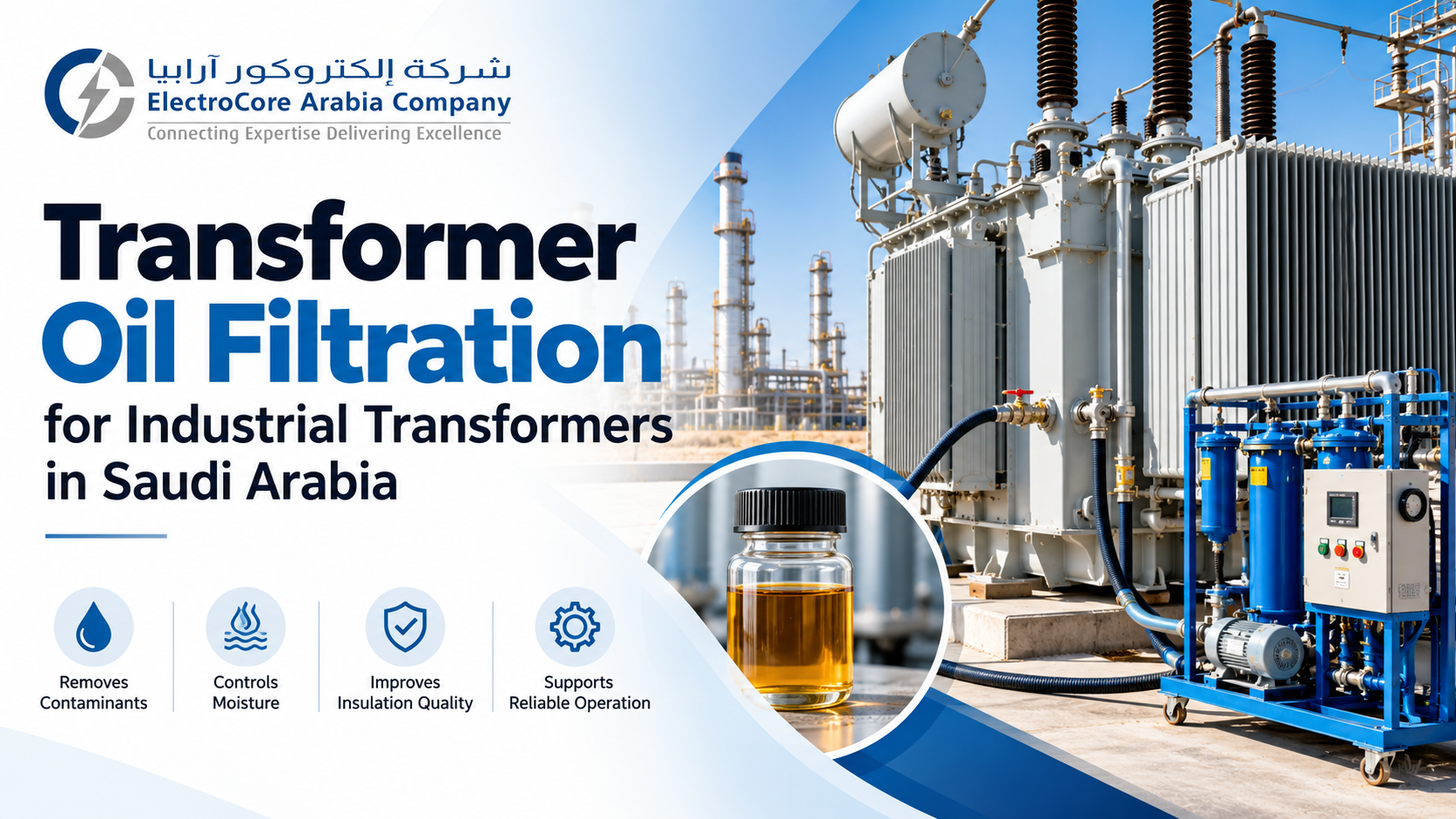
Industrial transformers play a critical role in maintaining reliable power distribution across manufacturing plants, oil and gas facilities, petrochemical industries, electrical substations, and power generation facilities. In Saudi Arabia, where industrial equipment operates under demanding environmental and electrical conditions, maintaining transformer oil quality is essential for reliable operations.
Transformer oil filtration is an important maintenance procedure that helps remove contaminants, control moisture, and maintain the insulating properties of transformer oil. When performed according to oil test results and equipment requirements, filtration can help reduce oil-related operational risks and support the long-term performance of industrial transformers.
ElectroCore Arabia provides transformer maintenance, oil diagnostics, and oil treatment solutions for industrial and power-sector applications across Saudi Arabia.
Transformer oil filtration is a treatment process used to remove suspended particles, moisture, and other contaminants from insulating oil. Transformer oil performs two essential functions: electrical insulation and heat transfer. It helps prevent electrical breakdown between internal components while carrying heat away from the transformer core and windings.
Over time, oil can become contaminated through moisture ingress, oxidation, dust, deteriorating insulation materials, and improper oil handling. These contaminants may affect dielectric performance and cooling efficiency, potentially increasing maintenance requirements.
Professional transformer oil filtration uses specialised processing equipment to circulate oil through filtration and, where required, vacuum dehydration and degassing stages. The appropriate treatment depends on the transformer design, oil condition, operating requirements, and laboratory test results.
Industrial facilities should evaluate transformer oil condition before selecting a filtration or purification procedure.
Industrial transformers frequently operate under continuous electrical loads. Maintaining oil quality is an important part of preventive maintenance, particularly in facilities where unexpected equipment interruptions can affect production and power distribution.
Moisture is a significant concern in transformer insulation systems. Water can enter through deteriorated seals, leaking gaskets, maintenance activities, or exposure to humid conditions.
Excessive moisture can reduce the dielectric strength of oil and contribute to the deterioration of solid insulation. Vacuum dehydration can help remove moisture from transformer oil when testing confirms that treatment is appropriate.
For facilities experiencing moisture-related problems, professional transformer maintenance and oil treatment services can help determine the most suitable maintenance approach.
Transformer oil helps insulate internal electrical components and maintain safe separation between conductive parts.
Suspended particles and moisture can adversely affect the oil’s dielectric properties. Filtration and appropriate oil treatment can help address certain forms of contamination, supporting the transformer insulation system.
Breakdown Voltage (BDV) testing is commonly used to evaluate an oil sample’s dielectric breakdown characteristics. However, BDV results should be interpreted alongside other relevant oil tests rather than used as the sole indicator of overall oil quality.
Transformer oil transfers heat away from the core and windings to the cooling system. Contamination, sludge formation, and unsuitable operating conditions can affect heat transfer and oil circulation.
Removing appropriate contaminants and addressing oil degradation can support effective cooling. Facilities should also inspect radiators, cooling fans, pumps, valves, and oil circulation pathways as part of a comprehensive transformer maintenance programme.
Routine oil testing and condition-based maintenance help engineers identify developing problems before they cause significant operational disruption.
Filtration may be recommended when test results indicate removable contaminants. Combining oil treatment with electrical testing, inspections, and condition monitoring provides a more complete understanding of transformer health.
Read our guide to transformer preventive maintenance for industrial facilities to learn how scheduled inspections and diagnostic procedures contribute to equipment reliability.
Industrial facilities in Saudi Arabia must consider environmental exposure, operating temperatures, equipment loading, and maintenance practices when managing transformer oil quality.
Common contamination concerns include:
It is important to distinguish between contamination that filtration can address and degradation or internal faults that require additional treatment or repair. Filtration alone cannot resolve every transformer oil problem.
Learn more about transformer oil contamination, its causes, and prevention to understand the common factors affecting oil quality and transformer reliability.
The filtration process should be selected according to the transformer’s condition, oil characteristics, and maintenance requirements. A typical service may include the following stages.
Engineers review the transformer’s operating condition, maintenance history, oil level, and visible signs of leakage. Oil samples may be collected for testing to establish the condition of the insulating oil before treatment.
Depending on the application, testing may include BDV, moisture content, acidity, and Dissolved Gas Analysis (DGA).
The filtration equipment is selected according to the transformer capacity, oil volume, required treatment, and site conditions.
Connections, hoses, valves, and processing equipment should be inspected before the operation. Appropriate safety procedures must be followed throughout the work.
Transformer oil is circulated through suitable processing equipment to remove targeted contaminants.
Depending on the equipment and treatment requirements, the process may incorporate particle filtration, vacuum dehydration, and degassing. These procedures address different oil-quality concerns and should not be treated as interchangeable.
Industrial facilities requiring specialised processing equipment can explore transformer oil filtration machine rental solutions from ElectroCore Arabia.
After processing, oil samples can be tested again to assess treatment effectiveness. Results should be compared with initial measurements and applicable technical requirements.
Additional transformer inspections or electrical tests may be necessary when the initial findings indicate a possible internal fault.
The final service record should document the work performed, test results, identified concerns, and recommended follow-up activities.
This information supports future condition monitoring and helps maintenance teams make informed decisions about transformer operation.
ElectroCore Arabia provides specialised transformer services for industrial and power-sector applications in Saudi Arabia. Its capabilities include transformer inspection, maintenance, electrical testing, oil diagnostics, and oil treatment.
The company also offers transformer oil filtration machine rental services for facilities requiring specialised oil-processing equipment and professional operator support.
Depending on the project requirements, the available equipment supports oil filtration, vacuum dehydration, and degassing applications.
These solutions can be relevant to:
Facilities can also explore ElectroCore Arabia’s broader electrical infrastructure services for related power-system maintenance requirements.
The appropriate service scope should be determined following a technical assessment of the transformer, oil condition, operating environment, and applicable safety requirements.
Transformer oil filtration should not be based solely on a fixed calendar schedule. Maintenance decisions should consider oil test results, transformer operating conditions, manufacturer recommendations, and historical performance.
Filtration or other oil treatment may be considered when:
Where DGA results suggest a developing internal electrical or thermal fault, engineers should investigate the underlying cause rather than relying on filtration alone.
A condition-based maintenance strategy helps ensure that the selected treatment addresses the actual problem.
Transformer oil filtration is an important component of industrial transformer maintenance in Saudi Arabia. By addressing removable contaminants and supporting appropriate moisture control, professional oil treatment can help maintain insulating oil quality and support reliable transformer operation.
However, effective maintenance requires more than filtration alone. Regular oil testing, leakage inspections, electrical diagnostics, and appropriate follow-up procedures are essential for evaluating transformer condition and identifying potential problems.
ElectroCore Arabia supports industrial and power-sector clients with transformer maintenance, oil diagnostics, filtration, and specialised oil-processing solutions.
Need transformer oil filtration for your industrial facility in Saudi Arabia? Contact ElectroCore Arabia to discuss your transformer oil condition, testing requirements, and suitable treatment options.
Copyright © 2026
ElectroCore Arabia Company. All Rights Reserved. Powered by Webtechnomind IT Solutions Pvt. Ltd
Sunday to Thursday: 8 am to 5 pm
Saturday: 9 am to 4 pm
Friday: Holiday
Copyright © 2026
ElectroCore Arabia Company. All Rights Reserved. Powered by Webtechnomind IT Solutions Pvt. Ltd