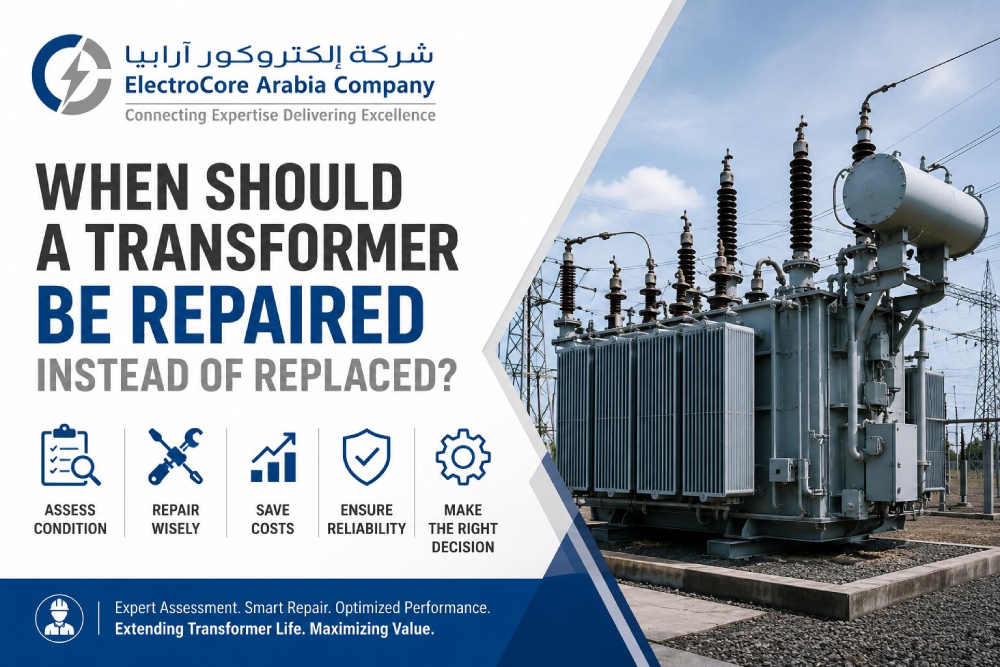
Power transformers are critical components of electrical power systems, industrial facilities, substations, and distribution networks. When a transformer develops a fault or begins showing signs of aging, one of the most important decisions is whether to repair the transformer or replace it completely.
Replacing a transformer can involve significant capital investment, installation work, testing, transportation, and downtime. On the other hand, repairing a severely damaged transformer may only provide a temporary solution and could increase operational risks.
So, when should a transformer be repaired instead of replaced?
The answer depends on the transformer’s condition, type of fault, age, maintenance history, expected remaining life, repair cost, operational importance, and future load requirements. A condition-based assessment is generally more reliable than using transformer age alone to make the decision.
A transformer should generally be considered for repair when the problem is localized, technically repairable, and the main transformer components remain in good condition.
Common repairable problems include:
If the transformer core, windings, insulation system, and main structural components remain healthy, repairing individual components can often restore reliable operation without the expense of complete replacement.
For example, a transformer with a failed cooling fan does not normally require complete replacement. Similarly, a minor oil leak caused by a damaged gasket can often be corrected through maintenance and component replacement.
Cost is one of the biggest factors in a transformer repair vs replacement decision.
However, the cheapest immediate option is not always the most economical long-term option. The assessment should consider the total lifecycle cost, including repair expenses, future maintenance, energy losses, downtime, expected remaining life, and the cost of a new transformer. Recent research on transformer asset management also emphasizes technical, economic, and operational factors when comparing repair and replacement options.
Repair may be preferable when:
For specialized or older transformers, repair can also be attractive because obtaining a replacement with exactly the same electrical characteristics, dimensions, connections, and installation requirements may be difficult.
Repair is not always the right answer. Replacement should be seriously considered when the transformer has extensive damage, poor remaining life, repeated failures, or no longer meets the requirements of the electrical system.
Major warning conditions include:
Winding damage is one of the most serious transformer problems. If a major internal fault has caused extensive winding deformation, insulation breakdown, or mechanical damage, the cost and complexity of rebuilding the transformer may become significant.
Additional diagnostic testing should be performed before deciding whether the active part can be restored.
The transformer core is fundamental to its operation. Severe core damage, overheating, insulation problems, or structural deformation can make repair economically unattractive.
When major components such as the core, tank, or windings are heavily damaged, complete replacement may be more practical than attempting an extensive rebuild.
If a transformer repeatedly develops faults despite regular maintenance and previous repairs, the issue may be more fundamental than a single failed component.
A history of repeated failures can indicate declining reliability and increasing maintenance costs. In such situations, replacement may provide a more dependable long-term solution.
Transformer insulation gradually deteriorates because of thermal stress, moisture, oxidation, electrical stress, and operating conditions.
Diagnostic testing can help determine whether insulation deterioration is localized or widespread. For oil-filled transformers, tests such as Dissolved Gas Analysis (DGA), moisture analysis, insulation power factor/tan delta, and other condition-monitoring techniques can provide valuable information about transformer health.
A deteriorating insulation system combined with other major defects can be a strong reason to consider replacement.
Not necessarily.
Transformer age should not be used as the only replacement criterion. Two transformers of the same age can have completely different health conditions because of differences in loading, maintenance, operating environment, moisture exposure, short-circuit events, and thermal stress.
A well-maintained older transformer with satisfactory diagnostic results may continue providing reliable service, while a younger transformer exposed to severe operating conditions may require major repair or replacement.
A transformer health assessment can consider factors such as:
Health-index-based approaches are commonly used to combine condition information with factors such as age, loading history, maintenance, failures, and asset importance when making inspection, repair, and replacement decisions.
Before deciding between transformer repair and replacement, a professional condition assessment should be performed.
Depending on the transformer type and suspected problem, the assessment may include:
These tests can help determine whether the problem is isolated or evidence of deeper deterioration.
For example, SFRA can be useful when investigating possible mechanical changes to transformer windings, particularly following short-circuit events or transportation. Combining multiple diagnostic results provides a stronger basis for decision-making than relying on one test alone.
There are actually three possible solutions, not just two:
Repair involves correcting a specific fault or replacing individual components while retaining the main transformer.
Best suited for: localized faults and healthy major components.
A major refurbishment can involve extensive disassembly, replacement of components, restoration of the active part, and other work intended to extend the transformer’s service life.
Best suited for: transformers with moderate deterioration where the main asset remains economically recoverable.
Replacement means installing a new transformer because continued operation or extensive repair is no longer technically or economically justified.
Best suited for: severe damage, poor condition, repeated failures, inadequate capacity, obsolete equipment, or unfavorable lifecycle economics.
Before making the final decision, ask:
Is the damage localized?
If yes, repair may be appropriate.
Are the core and windings healthy?
If yes, repair or refurbishment may be viable.
Has the transformer experienced repeated major failures?
If yes, replacement should be evaluated carefully.
Is insulation deterioration widespread?
If yes, replacement or major rebuilding may be more appropriate.
Does the transformer meet future load requirements?
If not, replacement may provide better long-term value.
Is repair substantially cheaper than replacement while providing adequate remaining life?
If yes, repair may be the better choice.
Will the repaired transformer provide acceptable reliability?
If not, replacement should be considered.
The decision to repair or replace a transformer should never be based solely on its age or the initial repair quotation. The transformer’s actual condition, failure history, diagnostic test results, operating requirements, remaining useful life, downtime implications, and lifecycle cost should all be considered.
In many cases, a transformer with a localized fault can be successfully repaired and returned to service. However, extensive winding or core damage, severe insulation deterioration, repeated failures, obsolete components, insufficient capacity, or unfavorable lifecycle economics can make replacement the safer and more cost-effective option.
The best approach is to conduct a professional transformer condition assessment before making the final decision. A data-driven assessment can help asset owners reduce unnecessary replacement costs while also avoiding the risks associated with keeping an unreliable transformer in service.
For critical electrical infrastructure, the goal should not simply be to choose the cheapest option—it should be to achieve the best balance between reliability, safety, performance, downtime, and total lifecycle cost.
Read More:
Copyright © 2026
ElectroCore Arabia Company. All Rights Reserved. Powered by Webtechnomind IT Solutions Pvt. Ltd
Sunday to Thursday: 8 am to 5 pm
Saturday: 9 am to 4 pm
Friday: Holiday
Copyright © 2026
ElectroCore Arabia Company. All Rights Reserved. Powered by Webtechnomind IT Solutions Pvt. Ltd