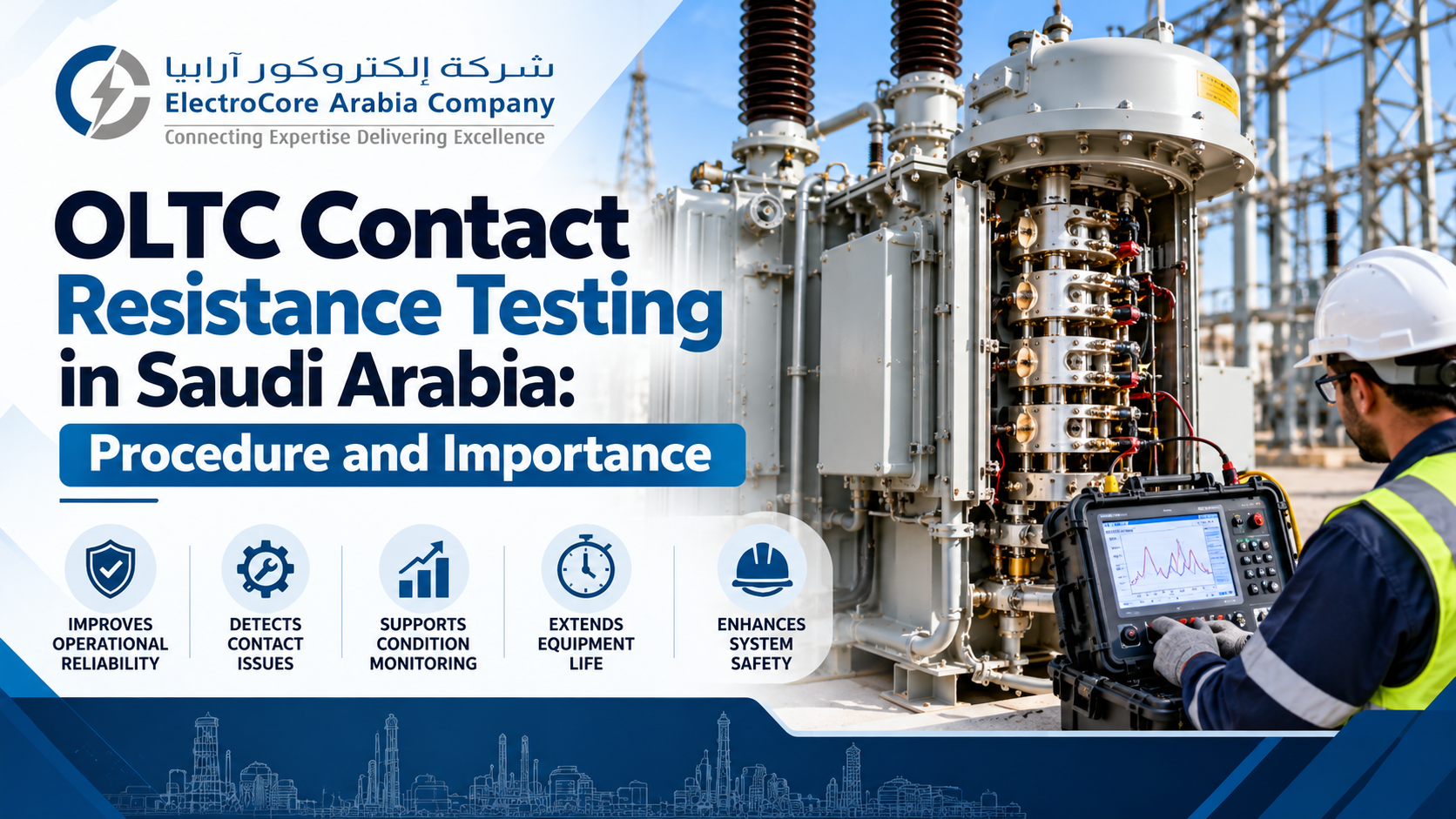
Power transformers play a critical role in electricity transmission, distribution, manufacturing, oil and gas operations, petrochemical plants, and industrial facilities throughout Saudi Arabia. One of the most important components of many power transformers is the On-Load Tap Changer (OLTC), which regulates transformer output voltage by changing tap positions while the transformer remains energized and carries a load.
Because OLTC contacts experience repeated electrical and mechanical stress, they can gradually deteriorate due to contact wear, arcing, contamination, oxidation, and inadequate contact pressure. These problems can increase electrical resistance, generate excessive heat, and affect transformer reliability.
OLTC contact resistance testing in Saudi Arabia helps maintenance engineers assess the electrical condition of tap changer contacts, identify abnormal resistance, and plan corrective maintenance before a developing problem causes an unexpected outage.
Electrocore Arabia supports transformer inspection, testing, and maintenance requirements for industrial and power-sector applications. Understanding the procedure and importance of contact resistance testing can help asset owners make informed decisions about transformer reliability and preventive maintenance.
OLTC contact resistance testing is an electrical diagnostic test used to measure the resistance of electrical contacts within an on-load tap changer circuit.
The test typically uses a micro-ohmmeter or a suitable low-resistance measurement instrument to measure very low resistance values. A controlled DC test current is passed through the relevant circuit, and the voltage drop across the test points is measured to determine resistance.
The basic relationship follows Ohm’s law: Resistance = Voltage ÷ Current.
The measured resistance helps engineers evaluate the electrical condition of contacts and associated current-carrying connections.
A healthy contact path should generally demonstrate low and reasonably consistent resistance within the applicable manufacturer specifications. An unusually high value, a significant difference between comparable phases, or a change from previous measurements may indicate a developing problem that requires further investigation.
The interpretation depends on the OLTC design, contact arrangement, tap position, test configuration, temperature, and manufacturer’s acceptance criteria.
OLTC contacts operate under demanding conditions. Repeated switching can cause erosion, pitting, material transfer, and other forms of contact deterioration.
As contacts wear, their effective contact area or contact pressure may decrease, increasing resistance across the current-carrying path.
Contact resistance testing helps engineers identify abnormal measurements that may indicate deterioration. Early identification allows maintenance teams to investigate the affected components and determine whether cleaning, adjustment, repair, or replacement is necessary.
Excessive contact resistance can generate additional heat when current passes through the contact. This heating may accelerate material deterioration and damage nearby components if the underlying problem remains unresolved.
Testing provides useful information about the electrical condition of the OLTC contact path. When combined with visual inspection, thermal assessment, and other diagnostic findings, it helps engineers evaluate potential overheating risks.
The OLTC allows a transformer to regulate its output voltage as system conditions and electrical loads change. If contact deterioration or switching-mechanism problems affect its operation, the transformer may experience unreliable tap changing or other operational abnormalities.
Contact resistance testing helps assess the electrical condition of the relevant contacts. It should be combined with functional, timing, and mechanical checks to determine whether the OLTC can operate as intended.
Transformer failures and unplanned maintenance can disrupt production, affect power distribution, and increase operating costs. For industrial facilities, petrochemical plants, utilities, and oil and gas installations in Saudi Arabia, reliable transformer operation is particularly important.
Including OLTC contact resistance measurements in an appropriate maintenance programme helps identify developing electrical abnormalities and supports better maintenance planning. For critical assets, OLTC contact resistance testing in Saudi Arabia can also help teams compare current results with historical measurements and prioritise follow-up inspections.
Rather than relying solely on visual inspection, maintenance teams can use electrical measurements to evaluate the condition of current-carrying contacts. Comparing present results with previous measurements can reveal resistance trends and help determine whether further investigation is needed.
This supports condition-based maintenance, allowing engineers to prioritise corrective action according to measured results, equipment criticality, and manufacturer recommendations.
The exact testing procedure varies according to the OLTC design, transformer configuration, manufacturer’s instructions, and applicable testing standards. The following steps describe a general approach for qualified transformer testing personnel.
Before testing begins, engineers should review the transformer nameplate, OLTC manufacturer’s documentation, electrical diagrams, previous test reports, and maintenance history. This information helps establish the correct test configuration, measurement points, applicable acceptance criteria, and required precautions.
The engineer should also determine whether the test requires access to particular contact circuits or tap positions.
Testing must be performed using an approved safety procedure. The transformer and relevant circuits must be placed in the required safe condition, with appropriate isolation, lockout/tagout, verification of absence of voltage, and grounding as required by the approved method.
Testing should only be performed by qualified personnel using suitable personal protective equipment and site-approved electrical safety procedures. OLTC testing must never be attempted on energized equipment unless a specific approved method expressly permits the activity and the necessary controls are in place.
A suitable low-resistance ohmmeter or micro-ohmmeter is connected to the designated test points according to the approved test procedure. The test instrument should be appropriate for the expected resistance range and current requirements.
Correct connections are essential because poor test-lead contact, unsuitable measurement arrangements, and external circuit effects can influence the results. Where applicable, four-wire Kelvin measurement techniques help reduce the influence of test-lead resistance.
The testing instrument applies a controlled DC current through the relevant contact path and measures the voltage drop. Resistance is then calculated and recorded for the specified circuit or contact arrangement.
The technician should follow the instrument manufacturer’s instructions, use the prescribed test current, and allow the measurement to stabilise where required. For OLTCs with different contact paths or switching configurations, measurements should be taken according to the equipment manufacturer’s procedure rather than assuming that every tap position can be tested identically.
Some OLTC designs require specialised methods to evaluate switching contacts, diverter switches, or transition components. In these cases, standard static resistance measurements may not be sufficient to assess every part of the switching sequence. Dynamic resistance measurement or timing analysis may be appropriate where recommended by the manufacturer or required by the diagnostic objective.
Depending on the OLTC design and approved test scope, measurements may be required at selected or multiple tap positions. The test plan should identify the positions and contact paths that need evaluation.
Recorded measurements should be compared with manufacturer-specified resistance limits, previous measurements for the same transformer, comparable phases or equivalent contact paths where applicable, results from other relevant electrical tests, and the OLTC’s maintenance and operating history.
A higher-than-expected resistance, an unexplained variation between phases, or a significant change from baseline results should be investigated. There is no single resistance limit that applies to every OLTC. Engineers must use the appropriate equipment-specific criteria and account for differences in test configuration.
The final report should record the equipment identification, test instrument, calibration status, test conditions, connections, tap positions, measurements, applicable acceptance criteria, and observations.
Where abnormalities are identified, the report should recommend suitable follow-up actions. Depending on the findings, these may include further diagnostic testing, internal inspection, contact cleaning, adjustment, component replacement, or OLTC overhaul. After any maintenance intervention, repeat testing may be appropriate to verify the results.
OLTC contact resistance testing can help identify electrical abnormalities associated with several potential problems:
Resistance measurements alone do not always identify the exact cause of an abnormality. A comprehensive diagnosis may require internal inspection, dynamic resistance testing, timing analysis, or additional transformer diagnostic tests.
The appropriate testing interval depends on transformer design, operating conditions, switching frequency, equipment criticality, manufacturer recommendations, and maintenance history.
Contact resistance testing may be appropriate during:
For industrial facilities in Saudi Arabia, OLTC contact resistance testing in Saudi Arabia should be scheduled according to operating demands, site requirements, equipment specifications, and applicable maintenance standards. Contact resistance testing should form part of a broader OLTC maintenance programme rather than being treated as the only indicator of tap changer health.
Saudi Arabia’s power, oil and gas, petrochemical, utility, and manufacturing sectors depend on reliable electrical infrastructure. Transformers operating in demanding industrial environments require maintenance strategies suited to their loading, operating conditions, and criticality.
OLTC contact resistance testing can be combined with other diagnostic activities to provide a more complete assessment of transformer condition. Depending on the equipment and maintenance scope, these activities may include:
Using the results together helps maintenance engineers distinguish potential contact problems from mechanical, insulation, control, or other electrical issues.
Electrocore Arabia provides transformer inspection, electrical testing and diagnostics, preventive maintenance, and OLTC/DETC services. Its tap changer service capabilities include inspection, maintenance, overhaul, contact replacement, and timing testing.
For organisations seeking transformer services in Saudi Arabia, an integrated maintenance approach can help coordinate OLTC assessment with the wider condition of the transformer.
Selecting a qualified transformer service provider is important when evaluating critical electrical equipment.
Electrocore Arabia provides transformer-related services covering inspection, diagnostics, maintenance, repair, and commissioning. Its published service capabilities include electrical testing, oil diagnostics and treatment, preventive and predictive maintenance, and OLTC/DETC inspection and servicing.
These capabilities can support industrial facilities that require a coordinated approach to transformer condition assessment and maintenance planning.
Organisations considering transformer condition assessment can use the results of relevant electrical tests alongside inspection findings, operating history, and manufacturer guidance to determine appropriate next steps.
For a broader maintenance strategy, facilities can also review this guide to transformer preventive maintenance for industrial facilities.
OLTC contact resistance testing measures the electrical resistance of specified current-carrying contact paths within an on-load tap changer. It helps identify abnormal resistance that may be associated with contact wear, contamination, poor connections, or other deterioration.
The test helps maintenance engineers assess contact condition, investigate possible overheating risks, compare measurements over time, and plan corrective maintenance. It is one component of a broader transformer diagnostic programme.
A suitable micro-ohmmeter or low-resistance ohmmeter is commonly used. The instrument, test current, connection method, and measurement procedure should be selected according to the OLTC design and manufacturer’s instructions.
Potential causes include contact wear, arcing damage, contamination, inadequate contact pressure, and deteriorated connections. Additional inspection and testing may be required to determine the actual cause.
There is no universal interval for every OLTC. Testing frequency should follow the manufacturer’s recommendations and consider switching frequency, transformer criticality, operating conditions, maintenance history, and previous results.
The test can help identify developing contact-related abnormalities before they progress. However, it cannot prevent every transformer failure and should be combined with appropriate inspections, electrical diagnostics, and preventive maintenance.
OLTC contact resistance testing is an important diagnostic activity for evaluating the electrical condition of on-load tap changer contacts. By measuring resistance, comparing results with manufacturer specifications, and reviewing historical trends, maintenance engineers can identify abnormalities that may require further investigation.
For power transformers operating in Saudi Arabia, OLTC contact resistance testing in Saudi Arabia can support reliable voltage regulation, improve maintenance planning, and reduce the risk of unexpected equipment outages.
Electrocore Arabia provides transformer testing, maintenance, inspection, and tap changer services for industrial and power-sector applications. Integrating contact resistance testing with appropriate electrical diagnostics and mechanical inspection helps organisations make informed maintenance decisions and protect critical electrical assets.
Copyright © 2026
ElectroCore Arabia Company. All Rights Reserved. Powered by Webtechnomind IT Solutions Pvt. Ltd
Sunday to Thursday: 8 am to 5 pm
Saturday: 9 am to 4 pm
Friday: Holiday
Copyright © 2026
ElectroCore Arabia Company. All Rights Reserved. Powered by Webtechnomind IT Solutions Pvt. Ltd