An On-Load Tap Changer (OLTC) is one of the most important components of a power transformer. It allows the transformer voltage ratio to be adjusted while the transformer remains energized and connected to the electrical system. By maintaining the required output voltage under changing load conditions, an OLTC plays a critical role in power system stability and reliability.
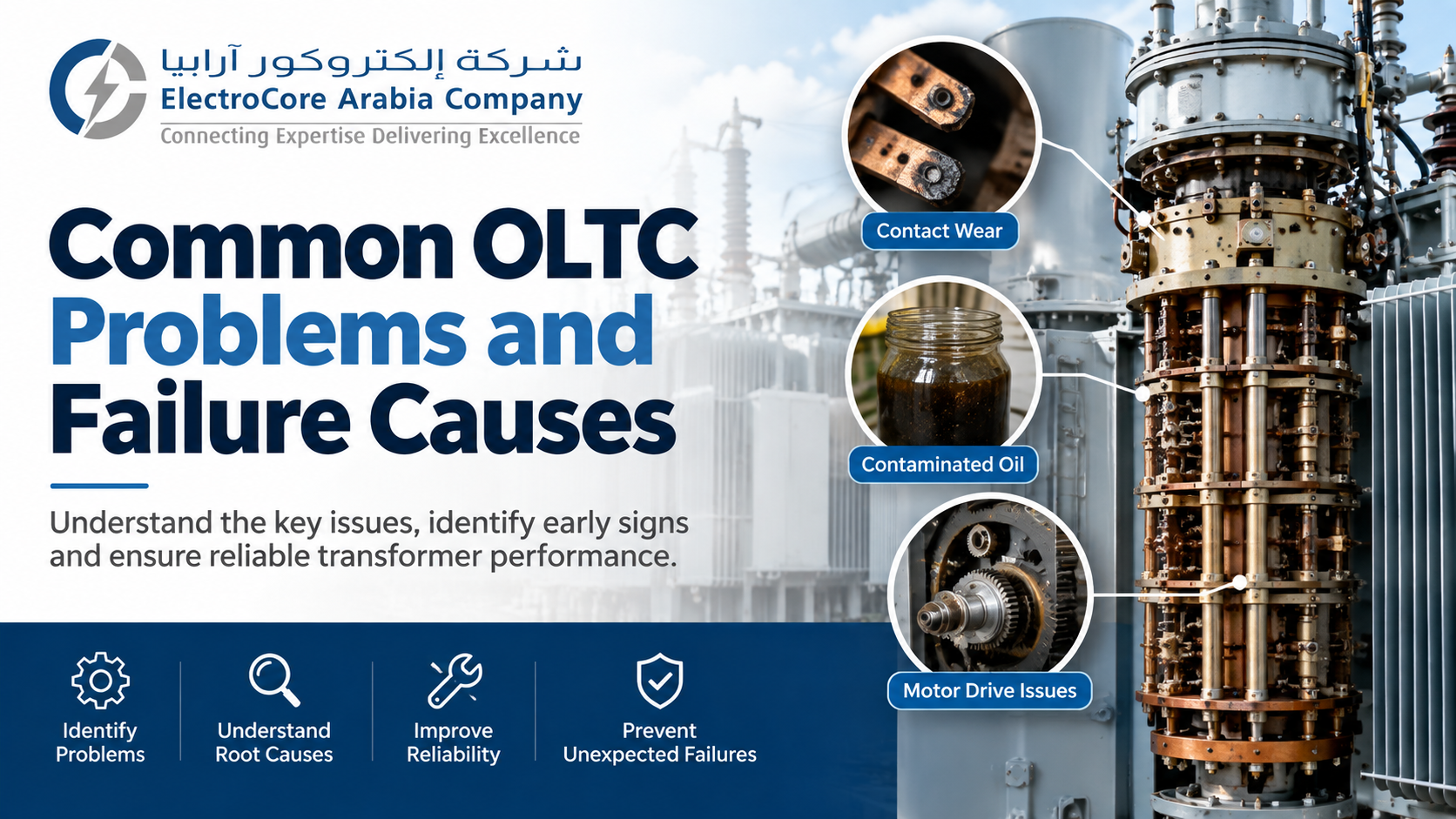
However, because OLTCs operate under electrical load and involve repeated mechanical movement, switching contacts, arcing, and control mechanisms, they are exposed to considerable electrical, thermal, and mechanical stress. Over time, this can result in OLTC problems, contact wear, oil contamination, motor-drive failures, and switching abnormalities.
Understanding the common OLTC failure causes can help transformer owners identify problems early, plan preventive maintenance, and reduce the risk of unexpected transformer shutdowns.
An On-Load Tap Changer is a switching mechanism installed in a power transformer to change the transformer turns ratio without interrupting the electrical supply.
An OLTC generally consists of several important components, including:
Every tap-changing operation places electrical and mechanical stress on these components. Therefore, regular OLTC inspection and testing are essential for reliable transformer operation.
Contact wear is one of the most common OLTC problems. During tap-changing operations, electrical arcing occurs between switching contacts. Repeated arcing gradually causes contact erosion, pitting, burning, and surface deterioration.
Worn contacts can increase electrical resistance and generate additional heat. If the problem is ignored, it may eventually result in poor switching performance or serious internal damage.
Regular contact inspection and OLTC contact resistance testing can help identify deterioration before it becomes a major failure.
Repeated switching operations can generate carbon particles and other contaminants inside an oil-filled OLTC compartment. Moisture, dirt, oxidation products, and degraded oil can further reduce the quality of the insulating medium.
Contaminated oil can negatively affect insulation performance and may contribute to abnormal switching and accelerated component deterioration.
Oil sampling, dielectric strength testing, moisture assessment, filtration, and appropriate oil treatment can help maintain OLTC reliability. ElectroCore Arabia also provides transformer oil diagnostics and treatment services as part of its transformer maintenance capabilities.
The OLTC motor-drive mechanism is responsible for physically moving the tap changer between positions. Problems with the motor, gears, shafts, bearings, drive belts, limit switches, or mechanical linkages can prevent the OLTC from reaching the required tap position.
Common symptoms include:
The motor-drive mechanism should therefore be inspected, lubricated, adjusted, and functionally tested according to the manufacturer’s requirements.
A faulty position indicator or control circuit can provide incorrect information about the actual OLTC position.
This can occur because of:
Incorrect tap indication can create operational risks because the control room may receive information that does not accurately represent the physical position of the tap changer.
Transition resistors or reactors are used during the tap-changing sequence to limit circulating current and maintain a controlled transition between tap positions.
If a transition resistor becomes damaged, overheated, or changes value beyond acceptable limits, the switching process may become abnormal. This can increase electrical stress and potentially cause severe OLTC damage.
Inspection and testing of transition components should therefore form part of a comprehensive OLTC maintenance programme.
An OLTC follows a defined mechanical and electrical switching sequence. Abnormal switching time can indicate problems with the diverter switch, contacts, motor-drive mechanism, springs, or other components.
Timing and sequence testing can help determine whether the OLTC is operating within the manufacturer’s specified parameters.
ElectroCore Arabia’s OLTC services include timing testing and operational sequence verification.
Oil leakage around the OLTC compartment, seals, gaskets, flanges, or connections should not be ignored.
Oil leakage can result from:
A falling oil level can affect insulation and cooling performance and may expose the equipment to additional operational risks.
OLTC mechanisms contain numerous moving parts that operate repeatedly throughout the transformer’s service life. Mechanical wear can affect gears, springs, shafts, bearings, linkages, and contact assemblies.
Misalignment can also cause excessive mechanical resistance and abnormal switching.
Regular inspection, cleaning, lubrication, and adjustment can reduce the likelihood of mechanical failure.
Several factors can contribute to OLTC failure. The most common include:
Transformers with frequently changing loads may require the OLTC to operate more often. A high number of switching operations accelerates contact wear and mechanical component fatigue.
Failure to inspect contacts, oil, drive mechanisms, and control systems can allow minor defects to develop into major failures.
Moisture, carbon particles, dirt, and other contaminants can reduce the effectiveness of OLTC insulating oil and accelerate component deterioration.
Excessive electrical loading, high contact resistance, poor connections, or inadequate cooling can cause abnormal temperatures and accelerate ageing.
Continuous operation gradually affects gears, bearings, springs, shafts, and other moving components.
Short circuits, abnormal currents, control circuit faults, and switching abnormalities can place additional stress on OLTC components.
Improper assembly, incorrect contact adjustment, incorrect torque, or misalignment can cause premature OLTC failure.
Older OLTC equipment may experience deterioration of insulation, contacts, mechanical components, seals, and control equipment.
Early detection is one of the most effective ways to reduce the risk of unexpected transformer failure.
A comprehensive OLTC inspection may include:
These tests should be interpreted together with transformer operating history and manufacturer specifications.
OLTC condition should also be considered as part of the overall transformer condition assessment rather than as an isolated component. ElectroCore Arabia’s transformer condition assessment services include evaluation of OLTC condition along with other major transformer components.
A well-planned preventive maintenance programme can significantly improve OLTC reliability.
Recommended practices include:
Condition-based maintenance is particularly valuable for critical transformers because changes in test results can reveal developing problems before a complete failure occurs.
OLTC maintenance involves high-voltage electrical equipment and complex mechanical switching systems. Incorrect inspection, testing, or assembly can create serious safety and equipment risks.
Professional maintenance teams can use appropriate diagnostic equipment and manufacturer-specific procedures to identify the root cause of OLTC problems.
ElectroCore Arabia provides specialized OLTC/DETC services, including inspection, cleaning, lubrication, adjustment, overhaul, contact replacement, and timing testing.
The company has also carried out a complete OLTC overhaul on a 60MVA power transformer, including diverter-switch disassembly, contact inspection and replacement, contact resistance measurement, motor-drive inspection, oil-compartment cleaning, and switching-sequence testing.
OLTC problems can develop gradually through contact wear, oil contamination, mechanical deterioration, motor-drive issues, abnormal switching, overheating, and inadequate maintenance. Because the OLTC directly controls transformer voltage regulation, its failure can affect the reliability and stability of the entire electrical system.
Regular OLTC maintenance, contact resistance testing, oil diagnostics, timing tests, mechanical inspection, and condition monitoring can help identify developing defects before they result in costly transformer outages.
For critical power transformers, a condition-based maintenance strategy supported by qualified professionals is an effective approach to improving reliability, extending equipment service life, and reducing the risk of unexpected OLTC failure.



Copyright © 2026
ElectroCore Arabia Company. All Rights Reserved. Powered by Webtechnomind IT Solutions Pvt. Ltd
Sunday to Thursday: 8 am to 5 pm
Saturday: 9 am to 4 pm
Friday: Holiday

Copyright © 2026
ElectroCore Arabia Company. All Rights Reserved. Powered by Webtechnomind IT Solutions Pvt. Ltd