
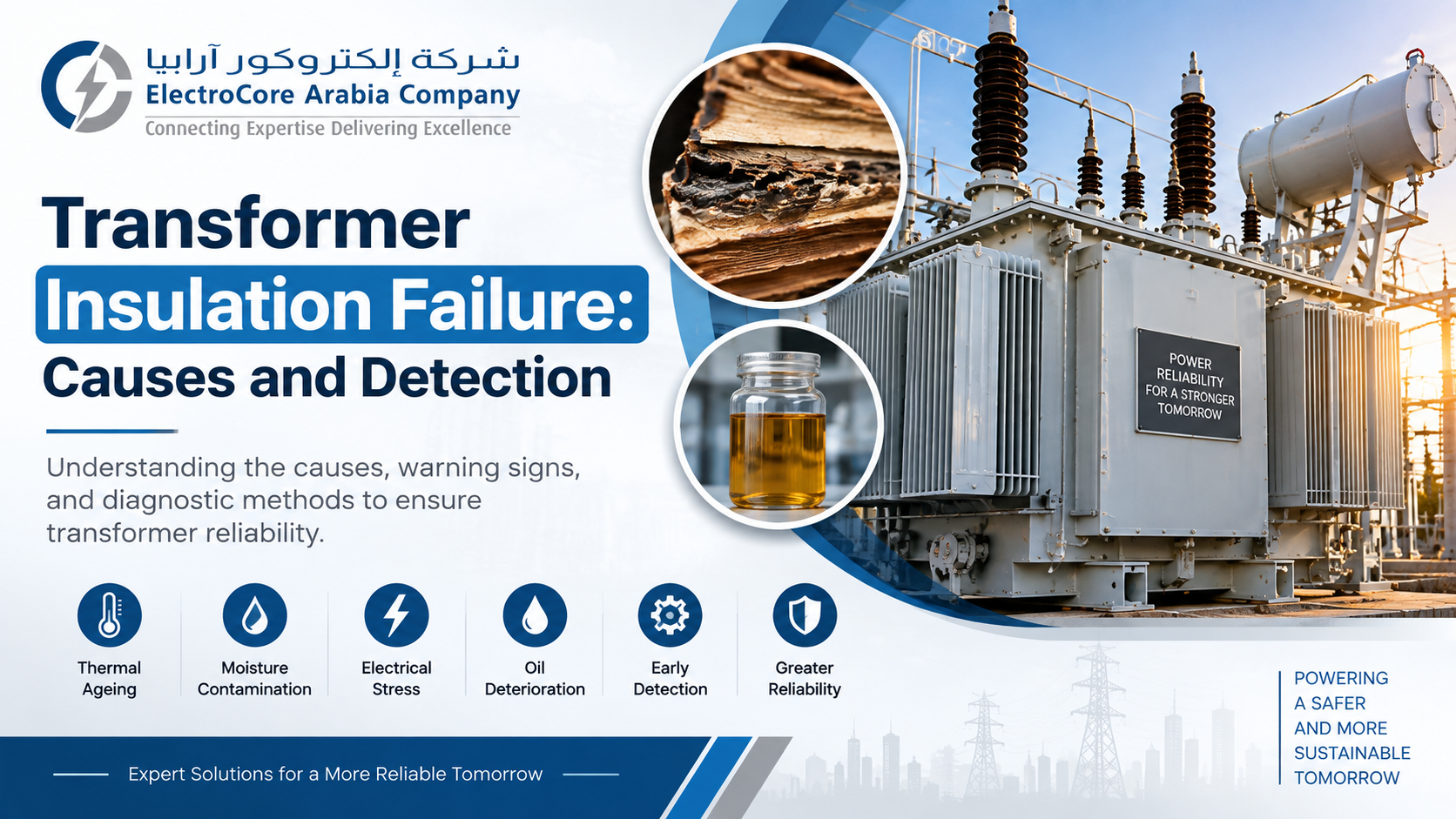
Transformer insulation is one of the most critical components of a power transformer. It electrically separates windings, conductors, the core, and other internal components while helping the transformer operate safely under high electrical and thermal stress. When insulation begins to deteriorate, the transformer can experience partial discharge, overheating, short circuits, winding damage, and, in severe cases, catastrophic failure.
For industrial facilities, substations, utilities, and other power-intensive operations, identifying insulation problems early is essential for maintaining transformer reliability and reducing unplanned outages.
ElectroCore Arabia provides transformer inspection, testing, diagnostics, maintenance, and repair services in Saudi Arabia, including insulation resistance testing, tan delta testing, partial discharge testing, DGA, SFRA, and other condition-monitoring techniques.
Transformer insulation failure occurs when the insulating system can no longer withstand the electrical, thermal, mechanical, or environmental stresses experienced during operation.
Transformer insulation generally includes solid materials such as paper and pressboard, as well as insulating oil in oil-filled transformers. As insulation deteriorates, its dielectric strength can decrease, increasing the possibility of electrical discharge or direct breakdown.
Insulation failure may develop gradually over years or occur suddenly because of a severe electrical fault, overheating, moisture ingress, mechanical damage, or other abnormal conditions.
Early diagnosis is therefore an important part of transformer maintenance and condition-based asset management.
High operating temperatures are among the major contributors to insulation ageing. Transformers naturally generate heat during operation, but prolonged overheating can accelerate the deterioration of paper and other solid insulation materials.
Overloading, inadequate cooling, blocked radiators, cooling-fan failure, poor oil circulation, and high ambient temperatures can all contribute to excessive thermal stress.
Regular temperature monitoring and cooling-system inspections can help identify conditions that may accelerate insulation deterioration.
Moisture is particularly harmful to transformer insulation. Water can enter a transformer through damaged seals, breathing systems, maintenance activities, leaks, or unsuitable storage conditions.
Excessive moisture can reduce the dielectric strength of insulating oil and adversely affect solid insulation.
Moisture assessment, oil testing, and appropriate dehydration processes can therefore form an important part of transformer condition monitoring. ElectroCore Arabia provides oil diagnostics, moisture measurement, dehydration, degassing, and oil treatment services as part of its transformer capabilities.
Electrical stress can gradually weaken insulation or create localized defects. Partial discharge (PD) is a localized electrical discharge that can occur in areas where insulation has defects, voids, contamination, or excessive electrical stress.
If left undetected, repeated partial discharge activity can progressively damage insulation and eventually contribute to a major insulation breakdown.
PD testing is therefore an important diagnostic technique for transformers showing abnormal insulation behavior. ElectroCore Arabia’s diagnostic capabilities include partial discharge detection and measurement.
For oil-filled transformers, insulating oil performs both electrical insulation and heat-transfer functions. Over time, oil can deteriorate because of oxidation, moisture, contamination, overheating, and other operating conditions.
Poor oil condition can negatively affect the transformer insulation system and increase the risk of internal faults.
Oil testing can include breakdown voltage (BDV), moisture, acidity, interfacial tension, and dissolved gas analysis (DGA). Depending on the results, filtration, dehydration, degassing, or reclamation may be required.
Short-circuit forces, transportation damage, vibration, improper assembly, or movement of winding components can damage insulation or alter winding clearances.
Even when external damage is not visible, electrical diagnostic testing can help identify abnormalities in the winding and insulation system.
Dust, dirt, oil contamination, chemical exposure, and foreign particles can affect insulation performance, particularly around bushings, terminals, and external insulation surfaces.
Regular inspections, cleaning, leak detection, and proper maintenance can reduce the risk of insulation-related problems.
Transformer insulation naturally ages with time. The ageing process is influenced by operating temperature, moisture, electrical stress, loading history, oil condition, and environmental conditions.
This is why historical diagnostic data is important. Comparing current results with previous measurements can reveal changes that may not be obvious from a single test.
There is no single test that can identify every insulation problem. A comprehensive assessment normally combines multiple diagnostic techniques.
Insulation Resistance (IR) testing measures the resistance of transformer insulation to leakage current.
A significant reduction in insulation resistance or an abnormal change compared with historical results may indicate moisture, contamination, deterioration, or another condition requiring further investigation.
However, acceptable readings depend on factors such as transformer design, temperature, insulation materials, age, and previous test results.
Tan delta, also called dissipation factor or power factor testing, helps evaluate dielectric losses in insulation.
Changes in the test results can indicate deterioration, moisture, contamination, or other insulation-related issues. It is particularly useful when combined with other electrical and oil diagnostic tests.
Partial discharge testing can help locate and evaluate localized insulation defects.
PD activity may indicate weaknesses within the insulation system, and trending the results over time can help maintenance teams determine whether the condition is stable or developing.
ElectroCore Arabia has carried out transformer internal inspection and PD root-cause analysis involving inspection of windings, insulation barriers, shields, bushings, and related components.
DGA is an important diagnostic technique for oil-filled transformers.
Electrical and thermal faults inside a transformer can produce gases that dissolve into the insulating oil. Analysing these gases can provide valuable information about potential internal faults.
DGA is most useful when results are interpreted alongside historical trends and other transformer diagnostic data rather than considered in isolation.
Dielectric Frequency Response Analysis (DFRA/DFR) can provide additional information about the condition of transformer insulation, particularly in relation to moisture and ageing.
It can complement insulation resistance and other electrical diagnostic methods when a more detailed condition assessment is required. ElectroCore Arabia lists DFR/DFRA among its transformer diagnostic capabilities.
Visual inspections can identify oil leaks, damaged bushings, contamination, corrosion, deteriorated seals, and other external conditions that may contribute to insulation problems.
Infrared thermography can also help identify abnormal temperature patterns and potential hot spots.
Maintenance teams should investigate the following signs:
These symptoms do not automatically confirm insulation failure, but they indicate that further professional assessment may be required.
A proactive maintenance program can significantly improve the ability to identify insulation deterioration before it develops into a major failure.
A suitable program may include:
ElectroCore Arabia’s Transformer Services cover inspection, preventive and predictive maintenance, electrical testing, oil diagnostics, cooling-system maintenance, tap changer services, and commissioning.
Transformer insulation failure can progress from a relatively small defect to extensive internal damage. Early detection gives asset owners an opportunity to investigate the root cause, plan corrective maintenance, and reduce the possibility of unexpected equipment failure.
A complete transformer condition assessment can combine insulation testing, oil diagnostics, winding assessment, bushing inspection, thermal inspection, and historical operating data to develop a broader picture of transformer health.
Transformer insulation failure can result from thermal ageing, moisture, electrical stress, partial discharge, oil deterioration, mechanical damage, contamination, and long-term operation. Because insulation problems may develop gradually, regular testing and condition monitoring are essential.
Insulation resistance testing, tan delta, partial discharge testing, DGA, dielectric frequency response analysis, oil testing, and thermal inspection each provide different information about transformer condition. Using these methods together can help maintenance teams detect developing problems and make informed decisions about repair, maintenance, or further investigation.
For transformer owners and industrial facilities in Saudi Arabia, a structured preventive and predictive maintenance strategy can help protect critical power assets and improve long-term reliability.



Copyright © 2026
ElectroCore Arabia Company. All Rights Reserved. Powered by Webtechnomind IT Solutions Pvt. Ltd
Sunday to Thursday: 8 am to 5 pm
Saturday: 9 am to 4 pm
Friday: Holiday

Copyright © 2026
ElectroCore Arabia Company. All Rights Reserved. Powered by Webtechnomind IT Solutions Pvt. Ltd