Transformers are essential components of electrical power systems, providing reliable power to industrial facilities, commercial buildings, utilities, oil and gas plants, manufacturing units, and infrastructure projects. However, continuous electrical loading, overheating, insulation deterioration, moisture, short circuits, and mechanical stress can eventually damage transformer windings.
When winding damage occurs, transformer rewinding can be an effective solution for restoring transformer performance without necessarily replacing the entire transformer.
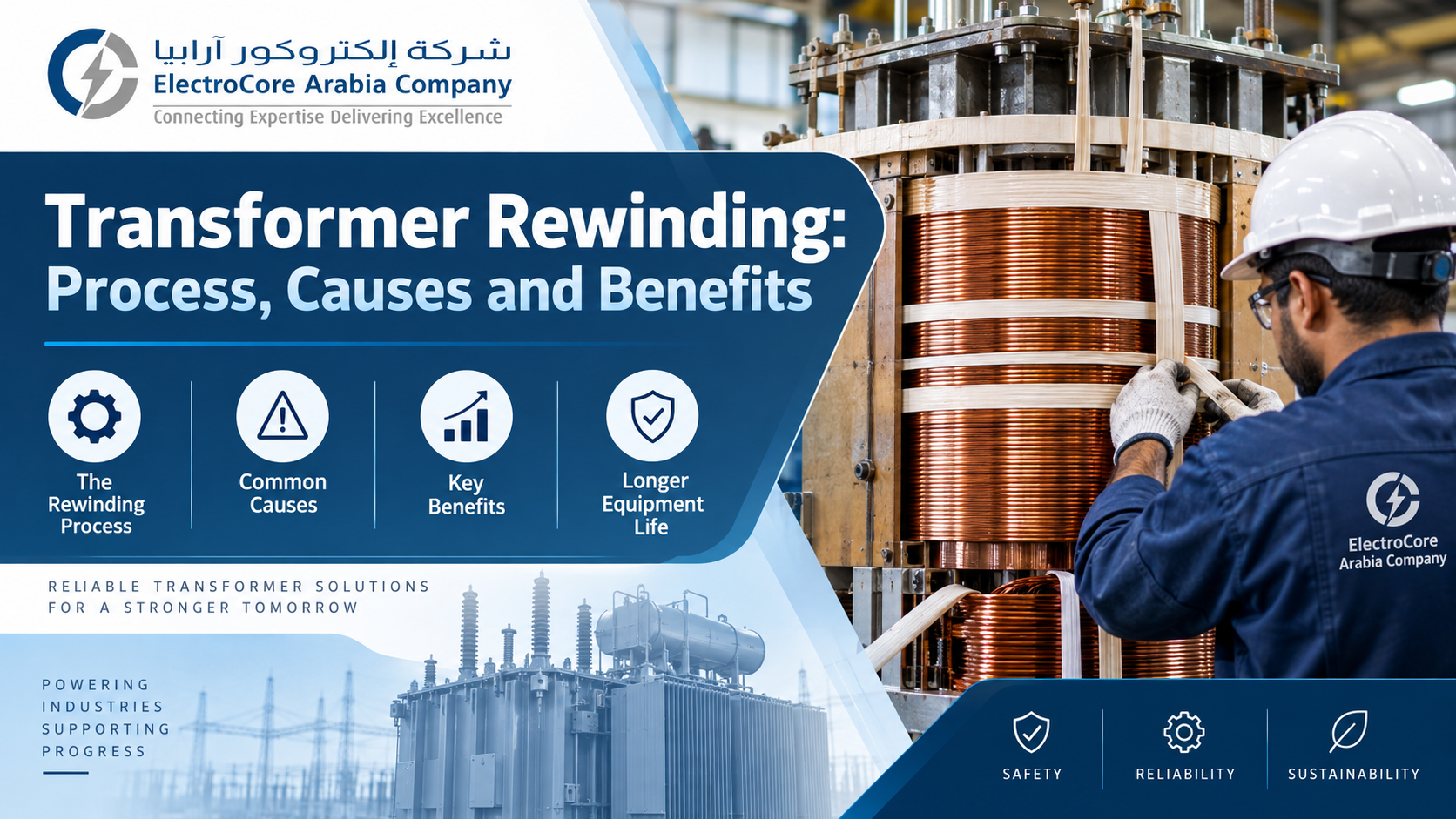
Transformer rewinding involves removing damaged or deteriorated windings, assessing the condition of the transformer core and other components, manufacturing new windings according to the required specifications, and completing comprehensive testing before returning the transformer to service.
For critical electrical assets, rewinding should always be supported by proper transformer testing and diagnostics to identify the original failure and verify the condition of the transformer. ElectroCore Arabia provides transformer inspection, diagnostics, maintenance, repair, testing, and commissioning services for power infrastructure in Saudi Arabia.
Transformer rewinding is the process of replacing damaged transformer windings with newly manufactured coils while retaining suitable components of the existing transformer.
Transformer windings are generally manufactured using copper or aluminium conductors and are surrounded by insulation systems designed to withstand electrical, thermal, and mechanical stresses.
When windings become severely damaged, the transformer may experience:
Before deciding on rewinding, a professional inspection should determine whether the transformer core, tank, insulation structure, bushings, cooling system, tap changer, and other major components are suitable for continued operation.
This is where a comprehensive transformer condition assessment can help determine whether repair, rewinding, refurbishment, or replacement is the most appropriate solution.
Understanding why transformer windings fail is important because replacing the winding alone may not resolve the underlying problem.
Continuous operation above the transformer’s rated capacity generates excessive heat. Prolonged overheating accelerates insulation ageing and can eventually cause winding insulation to deteriorate.
Overloading may result from increased production demand, changes in electrical loads, inadequate load management, or incorrect transformer sizing.
Regular preventive and predictive transformer maintenance can help identify abnormal operating conditions before they develop into major failures.
Transformer winding insulation naturally deteriorates with age. High temperatures, moisture, electrical stress, contamination, and repeated thermal cycles can accelerate this process.
Severely degraded insulation can result in winding-to-winding or winding-to-ground faults.
Electrical tests such as insulation resistance, tan delta, partial discharge, and other diagnostic techniques can provide valuable information about transformer insulation condition. ElectroCore Arabia provides these types of electrical testing and transformer diagnostics.
External and internal short circuits can expose transformer windings to significant thermal and mechanical forces.
High fault currents can deform or loosen winding conductors and damage the insulation system. Severe damage may ultimately require transformer rewinding.
Post-repair testing is particularly important because it helps confirm that the winding and transformer assembly are operating correctly.
Heat is one of the major factors affecting transformer insulation life.
Poor cooling performance, overloaded operation, blocked radiators, cooling-fan failure, pump problems, or deteriorated transformer oil can contribute to excessive transformer temperatures.
ElectroCore Arabia provides transformer cooling system maintenance, including radiator cleaning, fan and pump checks, thermal performance evaluation, oil leak repair, and flow testing.
Moisture can significantly affect the dielectric strength of transformer insulation and oil. Contaminated or degraded transformer oil can also reduce the effectiveness of the transformer’s insulation and cooling systems.
Oil condition should therefore be evaluated as part of the overall transformer maintenance strategy.
ElectroCore Arabia provides transformer oil diagnostics and treatment, including Dissolved Gas Analysis (DGA), moisture testing, acidity testing, breakdown voltage testing, filtration, dehydration, degassing, and oil reclamation.
For more information, businesses can also refer to ElectroCore Arabia’s guide on why transformer oil filtration matters for transformer performance.
Transformer windings can also be affected by mechanical forces generated during short circuits, transportation, vibration, loose components, or previous repair work.
Mechanical deformation may not always be visible externally, which is why specialized diagnostic testing can be valuable when investigating transformer winding problems.
A professional transformer rewinding process involves engineering assessment, controlled dismantling, precision winding manufacture, insulation treatment, assembly, and comprehensive testing.
The first stage is determining why the transformer failed.
Technicians inspect the transformer for signs of:
Electrical and oil diagnostic tests may also be performed to establish the root cause.
The transformer is carefully dismantled to gain access to the active part, including the core and windings.
Technical information such as transformer rating, voltage ratio, winding arrangement, conductor dimensions, and nameplate details should be documented before the rewinding process begins.
The damaged winding assembly is carefully removed from the transformer.
At this stage, the core, insulation structures, clamping arrangements, leads, connections, and other components are inspected.
Components that remain within acceptable condition may be refurbished and reused, while damaged components are replaced as required.
New winding coils are manufactured according to the transformer’s electrical and mechanical requirements.
Important parameters include:
Precision during this stage is essential because incorrect winding dimensions or configurations can affect transformer performance.
The newly manufactured windings are installed around the transformer core with the required insulation and mechanical support.
Proper positioning and compression are important because transformer windings must withstand electrical, thermal, and mechanical forces during normal operation and fault conditions.
After installation, the core-and-coil assembly is completed and appropriate drying and insulation treatment procedures are carried out.
For oil-filled transformers, the tank, bushings, oil system, cooling equipment, gaskets, and associated components should also be inspected before final assembly.
Where oil condition is a concern, transformer oil filtration and treatment may form part of the overall restoration process. ElectroCore Arabia’s capabilities include filtration, dehydration, degassing, reclamation, and regeneration depending on the equipment and oil condition.
Testing is one of the most important stages of transformer rewinding.
Depending on the transformer type and applicable requirements, testing may include:
ElectroCore Arabia’s transformer testing capability includes TTR, IR, winding resistance, tan delta, SFRA, DFRA, partial discharge, magnetic balance, excitation current, and other functional testing methods.
Transformer rewinding can be more economical than purchasing a completely new transformer when the core, tank, and other major components remain suitable for service.
Replacing damaged windings and restoring the insulation system can significantly extend the useful service life of a transformer.
This makes rewinding an attractive option for organizations looking to maximize the value of existing electrical assets.
A properly planned transformer repair or rewinding project may reduce the downtime associated with sourcing and installing an entirely new transformer.
This can be particularly important for manufacturing plants, power-generation facilities, oil and gas operations, and other industries where transformer failure can interrupt production.
A correctly engineered rewind can restore the transformer’s required voltage ratio, winding configuration, insulation system, and electrical characteristics.
Comprehensive post-repair testing provides additional confidence before the transformer is returned to service.
Rewinding may allow organizations to continue using an existing transformer tank, core, installation location, connections, and associated infrastructure when these components remain suitable.
Transformer rewinding can form part of a broader transformer maintenance and asset-health strategy.
Regular inspection, testing, oil analysis, cooling-system maintenance, and condition monitoring can help identify problems before they become major failures.
For transformers equipped with an On-Load Tap Changer (OLTC), the tap changer should also be evaluated during major transformer repair or refurbishment.
OLTC components experience electrical and mechanical stress during operation. Contact wear, oil contamination, mechanical problems, motor-drive issues, and switching abnormalities can affect transformer voltage regulation.
ElectroCore Arabia provides dedicated OLTC/DETC services, including inspection, cleaning, lubrication, adjustment, overhaul, contact replacement, and timing testing.
For additional information, see Common OLTC Problems and Failure Causes.
Transformer rewinding may be considered when significant winding damage has occurred but the transformer core, tank, insulation structure, and other major components remain suitable for continued operation.
However, rewinding should not automatically be selected for every failed transformer.
A professional assessment should consider:
A comprehensive condition assessment can help determine whether repair, rewinding, refurbishment, or replacement provides the best technical and economic outcome.
Transformer rewinding is more than simply replacing damaged copper or aluminium conductors. It requires engineering calculations, appropriate insulation materials, controlled manufacturing processes, mechanical precision, and comprehensive electrical testing.
The original cause of failure should also be investigated so that the same problem does not result in another transformer failure after rewinding.
ElectroCore Arabia provides an integrated range of transformer services covering inspection, diagnostics, maintenance, repair, testing, refurbishment, oil treatment, OLTC services, cooling-system maintenance, and commissioning. Its infrastructure includes advanced diagnostic equipment and capabilities for transformer assets up to 500 MVA.
The company has also carried out transformer internal inspection, overhaul, oil filtration, core and winding inspection, OLTC inspection, electrical testing, and commissioning projects, demonstrating an integrated approach to transformer restoration.
Transformer rewinding can be an effective solution when transformer windings have suffered serious damage but the transformer’s major components remain suitable for continued operation.
Overloading, overheating, insulation deterioration, moisture, oil contamination, short circuits, and mechanical stress are among the major causes of transformer winding failure.
A professional rewinding project should include:
For critical electrical infrastructure, transformer rewinding should be considered as part of a broader transformer condition assessment, maintenance, testing, and asset-management strategy.
With appropriate engineering, quality control, diagnostics, and testing, transformer rewinding can help organizations restore transformer performance, extend equipment life, reduce replacement costs, and minimize unplanned downtime.
For transformer owners and industrial operators in Saudi Arabia, ElectroCore Arabia’s transformer services provide an integrated approach covering transformer maintenance, diagnostics, testing, repair, refurbishment, oil treatment, OLTC services, and commissioning.



Copyright © 2026
ElectroCore Arabia Company. All Rights Reserved. Powered by Webtechnomind IT Solutions Pvt. Ltd
Sunday to Thursday: 8 am to 5 pm
Saturday: 9 am to 4 pm
Friday: Holiday

Copyright © 2026
ElectroCore Arabia Company. All Rights Reserved. Powered by Webtechnomind IT Solutions Pvt. Ltd