Transformers are essential components of modern electrical power systems. They transfer electrical energy between circuits while increasing or decreasing voltage according to system requirements. Because transformers operate under continuous electrical, thermal, and mechanical stress, their insulation systems must remain in good condition to ensure safe and reliable operation.
One of the most important diagnostic tests used to assess transformer insulation is insulation resistance testing. This test helps determine whether the insulation surrounding transformer windings is effectively preventing unwanted electrical leakage. Regular testing can help identify insulation deterioration, moisture, contamination, and other potential problems before they develop into costly transformer failures.
In this article, we explain what insulation resistance testing for transformers is, how it works, why it is important, how results are interpreted, and how it supports preventive transformer maintenance.
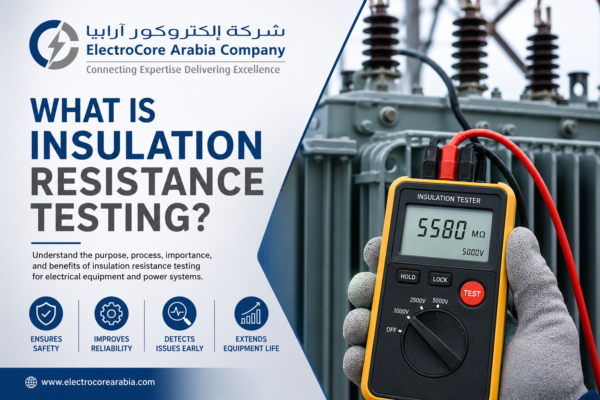
Insulation resistance testing is an electrical test used to evaluate the condition and effectiveness of insulation in electrical equipment, including power and distribution transformers.
During the test, a specialized instrument called an insulation resistance tester, commonly known as a Megger, applies a controlled DC voltage to the transformer’s insulation. The instrument measures the small amount of leakage current flowing through the insulation and calculates the resistance.
Insulation resistance is normally expressed in megaohms (MΩ) or gigaohms (GΩ).
In a properly insulated transformer, resistance to leakage current should generally be high. A low or significantly declining resistance reading can indicate that the insulation requires further investigation.
However, there is no single insulation resistance value that can be considered acceptable for every transformer. Results depend on transformer design, insulation materials, temperature, moisture, test voltage, age, and previous test history.
Transformer insulation naturally deteriorates over time. Several environmental and operating factors can accelerate this process.
Common causes of insulation deterioration include:
Moisture is particularly harmful because it can significantly affect the dielectric properties of transformer insulation. Excessive heat can also accelerate the ageing of paper and other solid insulation materials.
Regular insulation resistance testing allows maintenance teams to monitor insulation condition and identify changes before they become major problems.
Instead of waiting for a transformer to fail, organizations can use test results as part of a preventive or condition-based maintenance strategy.
Transformer insulation resistance testing must be performed by qualified personnel using appropriate safety procedures and testing equipment.
The general testing process includes the following steps.
Before testing begins, the transformer must be completely disconnected from all electrical sources. Appropriate isolation, lockout/tagout, grounding, and electrical safety procedures must be followed.
A transformer must never be tested while energized.
The transformer and its accessible components should be visually inspected before testing. Technicians may check bushings, terminals, connections, insulation surfaces, and other components for moisture, contamination, cracks, or physical damage.
The winding terminals are arranged according to the required test configuration. Depending on transformer construction, testing may be performed between windings and ground or between different windings.
The Megger or equivalent insulation resistance tester is connected to the appropriate transformer terminals.
Typical measurements can include:
The exact test arrangement should always follow the transformer manufacturer’s instructions and the applicable testing standard.
The tester applies a controlled DC voltage to the insulation. The appropriate voltage depends on the transformer design, winding voltage, insulation system, and applicable test procedure.
Common insulation resistance test voltages include 500 V, 1 kV, 2.5 kV, and 5 kV DC, although the correct test voltage must be selected based on the equipment and manufacturer’s recommendations.
The insulation resistance value is recorded at the specified test interval. A one-minute measurement is commonly used for insulation resistance testing, while longer tests may be performed for additional diagnostic analysis.
Technicians should also record the transformer temperature and environmental conditions because these can influence the measurement.
After testing, the transformer insulation can retain an electrical charge. The equipment must therefore be safely discharged and grounded before anyone works on or reconnects the transformer.
The insulation resistance value provides information about the condition of the transformer’s insulation system.
Generally, a higher resistance value indicates better resistance to leakage current. However, simply obtaining a high number does not automatically prove that a transformer is in perfect condition.
The most useful approach is to compare the latest reading with previous test results taken under similar conditions.
For example, if a transformer has historically produced stable insulation resistance readings but suddenly shows a significant reduction, this change may warrant further investigation.
Possible causes include:
Temperature is particularly important. Insulation resistance typically changes with temperature, so measurements should be temperature-corrected or compared at similar temperatures whenever appropriate.
Maintaining accurate transformer test records is an important part of an effective maintenance program.
A good test record should include:
Historical data allows maintenance professionals to identify trends rather than relying on a single measurement.
A gradual decline in insulation resistance over several maintenance cycles may provide an early warning that the transformer insulation is ageing or experiencing another developing problem.
Insulation resistance testing can be performed at several stages throughout the transformer lifecycle.
It may be recommended:
The testing frequency depends on transformer importance, operating environment, manufacturer recommendations, maintenance strategy, and applicable standards.
Critical transformers operating in demanding environments may require more frequent condition monitoring than less critical equipment.
Insulation resistance testing provides valuable information, but it should not normally be considered a complete transformer diagnostic program on its own.
Other transformer tests may include:
Each test evaluates different aspects of transformer condition. Combining multiple diagnostic techniques provides a more comprehensive understanding of transformer health.
Regular transformer insulation testing can provide several operational and financial benefits.
Testing can identify unusual changes in insulation condition before they develop into serious electrical faults.
Early detection allows maintenance teams to investigate problems before they result in unexpected shutdowns.
Planned maintenance can often be more cost-effective than emergency transformer repair or replacement.
Condition monitoring helps organizations schedule inspections and repairs during planned maintenance periods.
Identifying moisture, contamination, and insulation deterioration early can help prevent accelerated damage and support longer transformer service life.
Transformer insulation testing involves high-voltage electrical equipment and requires proper technical knowledge. Incorrect connections, inappropriate test voltages, poor grounding, or failure to discharge the transformer after testing can create serious safety risks.
Professional testing also requires proper interpretation of results. A reading should be evaluated alongside transformer design, temperature, previous measurements, operating history, and other diagnostic results.
For critical electrical infrastructure, transformer testing should therefore be performed by trained and qualified professionals using calibrated testing equipment and recognized procedures.
Insulation resistance testing for transformers is an important method for assessing the condition of transformer insulation and identifying potential problems before they lead to equipment failure.
By measuring insulation resistance between windings and ground or between selected windings, technicians can gain valuable information about possible moisture, contamination, ageing, or insulation deterioration.
The most effective approach is not simply to look for a single “good” resistance value. Instead, transformer owners should monitor readings over time, account for temperature and test conditions, and combine insulation resistance testing with other transformer diagnostic techniques.
A properly planned transformer maintenance program can improve reliability, reduce unexpected downtime, support safer operation, and help extend the service life of valuable electrical equipment.
For organizations operating critical power infrastructure, regular transformer testing and condition monitoring are important investments in electrical safety, reliability, and long-term asset performance.
Copyright © 2026
ElectroCore Arabia Company. All Rights Reserved. Powered by Webtechnomind IT Solutions Pvt. Ltd
Sunday to Thursday: 8 am to 5 pm
Saturday: 9 am to 4 pm
Friday: Holiday
Copyright © 2026
ElectroCore Arabia Company. All Rights Reserved. Powered by Webtechnomind IT Solutions Pvt. Ltd